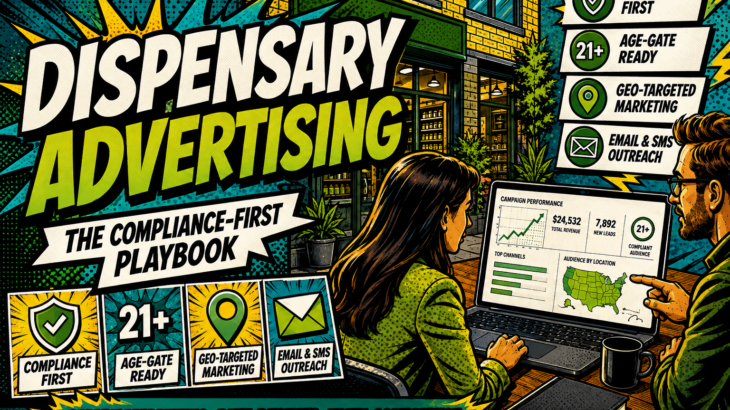
California Cannabis Internet Marketing That Moves the Needle

Key Takeaways

  • California cannabis internet marketing works only when compliance comes first.
  • State law requires ads to reach audiences of at least 71.6% adults 21 and older.
  • Meta bans most cannabis ads. Google approves only limited campaigns.
  • SEO, email, and SMS drive owned growth without platform gatekeepers.
  • Programmatic and Connected TV open compliant paths to mainstream inventory.
  • A compliance-first partner turns strict rules into a real edge.

Introduction

In a world of shadowbans and strict rules, playing it safe is the fastest way to fall behind.

California runs the largest legal cannabis market in the country. That also makes it the most crowded. Dispensaries fight for the same customers, the same keywords, and the same narrow ad windows. Most lose ground because their marketing ignores the rules until a campaign gets flagged.

Smart operators flip that order. They build compliance-first cannabis marketing in California before they spend a dollar. That approach protects your license and your budget at once.

Seedless Media was born from the love of cannabis. We know this space because we live in it. Our team brings over 30 years of combined experience and a track record of more than $980k in client revenue.

One note before we dig in. This guide covers marketing strategy only. It is not legal advice. Always consult qualified compliance or legal counsel for your situation.

Here is what most dispensaries get wrong.

Why California Cannabis Marketing Is Different

California does not treat cannabis like any other product. State law limits where and how you promote. Miss a rule, and you risk fines or a suspended license.

The platforms punish you, too. Meta bans almost all cannabis ads. Google approves only a narrow set of campaigns. Traditional playbooks simply do not apply here.

So dispensaries need a different engine. That engine runs on owned channels, sharp targeting, and airtight compliance. Get those three right, and growth follows.

Ready to see the rule that shapes every campaign?

Compliance-First: The Rule That Shapes Everything

Every compliant campaign starts with your audience. In California, cannabis ads may run only where most viewers are adults. The California Department of Cannabis Control sets the standard.

At least 71.6% of your audience must be reasonably expected to be 21 or older. Direct messages, like email and SMS, need age verification before you send. These rules apply across print, radio, broadcast, and digital.

A few more limits shape your copy and creative:

Rule What it means for your marketing
71.6% audience threshold Target only channels and lists that skew adult 21+.
No appeal to minors Skip cartoons, toys, and youth-style imagery.
No false or health claims Never promise medical benefits or cures.
Age-gate direct messages Verify age before any email or SMS contact.
Include the 21+ disclaimer Add “For use only by adults 21 and older.”

Follow this table, and you will build on solid ground. Break it, and one flagged ad can stall your whole account.

Now, let’s talk about the channels that actually grow your brand.

Channels That Move the Needle

You cannot lean on platforms that ban you. You can own your growth instead. These channels put you in control.

SEO and Local Search

Most cannabis journeys start with a Google search. Strong dispensary SEO in California puts your menu in front of ready buyers. Local optimization wins the “near me” moment.

Email and SMS

Owned lists beat rented audiences every time. Email marketing and text message marketing drive repeat visits. First-party data powers hyper-segmentation, so the right offer reaches the right shopper.

Programmatic and Connected TV

Blocked from mainstream platforms? Compliant programmatic partners open the door. According to Cannabis Business Times, programmatic and Connected TV now give dispensaries fresh paths to mainstream inventory. Geo-targeting keeps every impression legal and local.

Expert Insight: The platforms that reject you are a gift.

Most dispensaries burn cash trying to sneak past Meta and Google. That is backward. The ad bans actually push you toward assets you own. Email lists, SMS subscribers, and search rankings never get shut off by a policy change. The dispensaries that win in California treat owned channels as the foundation, not the backup plan.

Once your channels are set, you need a plan to run them.

A Compliance-First Growth Plan

Growth is not luck. It follows a repeatable path. Here is the one we use to cultivate success.

  1. Audit your compliance. Review every ad, list, and age-gate against state rules.
  2. Fix your foundation. Clean up your site, menu, and local SEO first.
  3. Build owned channels. Grow email and SMS lists with age verification.
  4. Layer in compliant paid. Add programmatic and CTV through vetted partners.
  5. Segment and scale. Use first-party data to repeat what works.

Work the steps in order. Each one makes the next one stronger.

This is where the right partner changes everything.

How Seedless Media Cultivates Success

You are the expert on your dispensary. We are the guide that gets you found. That is the point of a specialist partner.

We build compliance-first strategies that move the needle, not vanity metrics. We handle PPC Google Ads, programmatic display, SEO, email, and SMS under one roof. Every campaign ties back to conversions and real revenue.

Skip that structure and the costs add up fast. Flagged ads, wasted spend, and lost rankings pile on quietly.

So let’s plant the seeds for real growth instead.

Frequently Asked Questions

Is cannabis internet marketing legal in California?

Yes, it is legal when campaigns follow state rules. Ads must reach audiences of at least 71.6% adults 21 and older. You must avoid medical claims and age-gate direct messages.

Can dispensaries advertise on Google and Facebook in California?

No, direct advertising is heavily restricted. Meta bans nearly all cannabis ads. Google approves only limited campaigns. Owned channels like SEO, email, and SMS give you more reliable reach.

What is the 71.6% rule for California cannabis ads?

The 71.6% rule is a state requirement. Ads may run only where most viewers are reasonably expected to be 21 or older. It applies across broadcast, print, and digital.

How can dispensaries market compliantly without paid ads?

Owned channels are the answer. SEO, email, SMS, and content build an audience you control. First-party data powers hyper-segmentation and drives repeat sales.

The Bottom Line

California rewards dispensaries that market smart and stay compliant. Owned channels, sharp targeting, and clean campaigns turn strict rules into an edge. That is how you win a crowded market.

This guide is for education only. It is not legal advice. Consult qualified compliance or legal counsel before launching any campaign.


What Cannabis Brands Should Know Before Hiring Influencers

Key Takeaways

  • Cannabis brands face ad bans, so influencers offer rare organic reach.
  • Social media builds brand awareness. It rarely drives direct cannabis sales.
  • The FTC requires clear disclosure of any paid influencer partnership.
  • Brands, not just creators, share legal liability for missing disclosures.
  • Influencer buzz works best inside an omnichannel plan tied to SEO.
  • Measure branded search lift, not likes, to prove real growth.

Introduction

In a world of shadowbans and strict ad rules, playing it safe online can leave your brand invisible. Cannabis companies cannot buy their way onto most feeds. So many turn to influencers instead.

That choice makes sense. Influencers reach real people where paid ads cannot go. They also bring a kind of trust that a banner never will.

But hiring a creator is not a magic fix. It carries real compliance risk and real strategy questions. Done right, it strengthens your place in cannabis culture and supports your whole funnel. Done wrong, it wastes budget and invites trouble.

This guide breaks down what cannabis brands should know first. We pull from federal disclosure rules and live platform policies. As a cannabis advertising agency built for this industry, Seedless Media often sees these mistakes.

This article shares a marketing strategy, not legal advice. Rules vary by state and platform, so confirm your plan with a licensed marketing, legal, or compliance professional. Always target audiences 21 and older.

First, let us look at why so many brands take this path.

Why Cannabis Brands Turn to Influencers

Most big platforms block cannabis ads outright. Meta’s advertising rules prohibit ads that promote THC products. CBD ads face heavy limits, too. They require special certification, may not make health claims, and must target adults.

Organic posts are not safe either. Cannabis operators report shadow bans and account closures on Instagram. A post that says “buy here” often gets flagged fast.

So paid social is mostly off the table. That is exactly why influencers matter. A creator can mention your brand in their own voice. Their reach is organic, and their audience already trusts them.

This makes influencers one of the few remaining open doors. But an open door still has rules. Next, let us reset what social media actually does for a cannabis brand.

Social Media Builds Awareness, Not Direct Sales

Here is the mindset shift. For cannabis, social media is a brand awareness channel. It is not a checkout line.

You usually cannot link straight to a sale. You cannot run normal retargeting either. So likes and follows are not the real prize.

The real prize is memory. When someone needs a product, your name should surface first. That is brand awareness, and it is a long game.

Smart operators stop chasing vanity metrics. They focus on reach, recall, and branded searches instead. Those signals move the needle. A viral post means little if no one remembers your brand a week later.

Influencers fuel this awareness engine well. The next question is how to hire them without breaking the rules.

What to Know Before You Hire an Influencer

The biggest risk is disclosure. The Federal Trade Commission treats paid posts as ads. Its disclosure guidance for influencers is clear and strict.

Here is what every cannabis brand should lock down first.

  1. Disclose every material connection. Money, free product, and perks all count.
  2. Make the disclosure obvious. Place it early, not buried in hashtags.
  3. Share the liability. Brands and agencies can be held responsible, not just creators.
  4. Vet the creator’s audience. Confirm most followers are adults 21 and older.
  5. Skip health claims. No cures, no dosing advice, no medical promises.
  6. Check state rules. Cannabis ad laws differ in every single market.

A written agreement should spell out each point. It protects your brand if a post goes sideways.

Expert Insight: The real ROI of cannabis influencers hides off-platform

Most brands grade an influencer campaign by likes and comments. That is the wrong scoreboard. Because you cannot sell on social, the real payoff shows up downstream. Watch your branded search volume and direct site traffic in the two weeks after a post. A clear lift there means the creator built memory, not just noise. That memory feeds your SEO and your entire funnel.

So where does that downstream value actually land? Inside your omnichannel system.

How Influencer Buzz Fits Your Omnichannel Plan

Influencer awareness is the spark. It is not the full fire. The brands that win connect that spark to their own channels.

Here is the honest part. Seedless Media does not run social media advertising or broker influencer deals. We build the channels that capture the demand that those creators create.

Think of it as a relay. Social hands the baton to search. Search hands it to your site. Your site hands it to email and text. Each stage moves a curious fan closer to a sale.

Funnel Stage Channel Its Job Seedless Service
Awareness Influencers and social Spark interest and recall Not offered (free education only)
Discovery Search engines Capture branded searches SEO
Reach Mainstream sites and apps Retarget regulated audiences Geo-targeted display
Nurture Email Turn visitors into repeat buyers Email marketing
Loyalty Text message Keep customers coming back SMS marketing

Notice the through-line. A fan who sees an influencer’s post often searches your name next. Strong cannabis search engine optimization makes sure they find you, not a competitor. That is why social and SEO are tightly linked.

From there, owned channels do the heavy lifting. Our email flows handle cannabis dispensary email marketing, turning one-time visitors into regulars. This is where a focused dispensary marketing company earns its keep.

So a single creator post can ripple across your whole funnel. The trick is having the rest of the system ready.

Frequently Asked Questions

Can cannabis brands advertise on Instagram?

No. Paid cannabis ads are mostly banned on Instagram and Facebook. Meta blocks THC promotion entirely. CBD ads need special certification and face strict limits. Most brands rely on organic posts and influencers instead.

Do influencers have to disclose paid cannabis posts?

Yes. Disclosure is required whenever money, products, or perks change hands. The FTC expects a clear, early label that any viewer can spot. Brands and agencies share this duty, not just the creator.

Is influencer marketing worth it for small dispensaries?

Yes, it can be, especially when budgets are tight and ads are blocked. A trusted local creator builds awareness cheaply. The key is pairing that buzz with strong SEO so new fans find you online.

Does social media help cannabis SEO?

Yes, indirectly. Social posts are not a direct ranking factor. But they drive branded searches and site visits. Those signals support your SEO and help your shop rank for local terms.

How do I measure cannabis influencer results?

No single line tells the story. Track branded search volume, direct traffic, and new email signups after a campaign. Those numbers show real awareness. They prove the creator moved the needle, not just the feed.

Conclusion

Hiring influencers can open doors that ads keep shut. It gives cannabis brands rare organic reach and real trust. But the payoff depends on smart, compliant execution.

Treat social media as a brand awareness engine. Disclose every partnership. Then connect that awareness to the owned channels that actually convert. That is how buzz becomes organic growth.

This article shares strategy, not legal advice. Confirm any campaign with a licensed marketing, legal, or compliance professional, and always target adults 21 and older.

Ready to Grow?

Ready to turn awareness into action? Seedless Media is a cannabis dispensary digital marketing agency that builds the SEO, email, and text channels behind your brand, the core of our dispensary marketing services. Explore more of our work in cannabis culture, then schedule your strategy call. Let us help you click and grow.


Turn One Cannabis Event Into a Month of Dispensary Marketing

Key Takeaways

  • One cannabis event can fuel about four weeks of compliant content.
  • Capture photos, video, and quotes live, then repurpose them everywhere.
  • Owned channels like email, SMS, and SEO beat restricted paid ads.
  • A compliance-first plan protects your accounts and your brand.
  • Geo-targeting turns local event buzz into nearby foot traffic.
  • A cannabis advertising agency can systemize the whole workflow for you.

Introduction

Most dispensaries treat events like one-night stands. The party ends. The content dies with it the next morning.

That is money left on the table. One well-run event holds enough raw material to feed your channels for a full month. You just need a system to capture it and a plan to release it.

Smart operators stretch a single night into weeks of organic growth. They turn one room full of regulated audiences into recaps, clips, emails, and search traffic. This is exactly the kind of work we plan around our cannabis events hub at Seedless Media.

This guide is marketing education, not legal or medical advice. Keep all content 21+ and avoid any health or medical claims. Always consult a licensed marketing, legal, or compliance professional before you publish.

Here is the part most operators miss.

Why One Event Is a Content Goldmine

An event gives you something that ads cannot easily buy. It gives you real people, real reactions, and real moments. That authenticity is gold in cannabis culture.

You already paid for the venue, the staff, and the vendors. The content is a free byproduct. Capturing it costs almost nothing, yet most teams walk away with three blurry phone photos.

Think of the event as a harvest. The night is the harvest day. The next 30 days are when you actually cook with what you picked. That mindset is how you move the needle without spending more.

So how do you capture enough to last a month?

Capture Everything Before, During, and After

The secret is not talent. It is a checklist. Assign roles before the doors open so nothing slips through.

Use this simple capture plan at your next event:

  1. Assign one person to shoot photos and short video clips.
  2. Record quick customer reactions and friendly staff intros.
  3. Save vendor moments and product highlights for later posts.
  4. Collect emails and phone numbers with a clear 21+ opt-in.
  5. Write down strong quotes for social proof and testimonials.

Shoot more than you think you need. Vertical video works best for social. Wide shots show energy, and close shots show detail.

Now you have a full library. Next comes the part that actually drives revenue.

The Expert Insight Most Agencies Skip

Expert Insight: Your owned channels outperform paid ads in cannabis.

Most brands chase paid reach and hit a wall fast. Google’s ad policies restrict cannabis promotion, allowing only limited topical hemp-CBD ads in a few states. Meta and TikTok block most cannabis ads, too.

So the channels you control become your real engine. Email, SMS, and search never get your account suspended for posting a recap. That is why we build event content around owned channels first. It is durable, compliant, and yours.

This single shift changes how you plan every event. Build for channels you own, then borrow reach from organic social.

Ready to see the month laid out?

Your One-Event Content Calendar

A month of content needs rhythm, not randomness. Spread your assets so each week has a clear job. Each channel does what it does best.

Here is a simple four-week repurposing map:

Week Primary Channel Content Asset Goal
Week 1 Email + SMS Recap with photo gallery and thank-you Re-engage attendees fast
Week 2 Blog and SEO Long-form recap with local keywords Capture nearby search traffic
Week 3 Organic social Short clips and customer quotes Build reach and trust
Week 4 Display and geo-targeting Retarget engaged local visitors Drive return store visits

Notice the flow. You start warm with people who showed up. Then you reach the regulated audiences who missed it.

By Week 4, you are pulling new foot traffic from the same single event. That is how one night funds a month of dispensary marketing. But none of it works without compliance.

Stay Compliant While You Scale

Speed is useless if it gets your accounts banned. Compliance-first is not a brake. It is what keeps your content alive.

Three rules protect every event campaign. First, gate all content to 21+ and follow your state rules. Second, skip medical claims, dosage advice, and any health promises. Third, disclose paid partnerships clearly.

That last one trips up many brands. If you pay or gift a creator, the post is an endorsement. The FTC’s disclosure rules for social media require an obvious label on the post itself. A buried hashtag is not enough.

Your recap blog deserves the same care. Google rewards helpful, people-first content written for real readers. Write the recap to inform attendees, not just to rank, and the rankings tend to follow.

Now, let us answer the questions operators ask most.

Frequently Asked Questions

Can dispensaries advertise events on Google or Facebook?

No. Paid cannabis promotion is heavily restricted on major platforms. Owned channels like email, SMS, and search are safer and more reliable for stretching event content over time.

How long should event content last?

Yes, one event can stretch about a month. Plan to release captured photos, videos, and recaps in waves across your channels for roughly four weeks.

Do I need disclosures for creator or staff posts?

Yes, disclosures are required. The FTC treats paid or gifted posts as endorsements, so creators and staff must clearly label any material connection upfront.

Is event content good for SEO?

Yes, event recaps are strong SEO fuel. Fresh, local, people-first pages help nearby audiences find your dispensary when they search after the event.

Should I age-gate event content?

Yes, age-gating is essential. Most platforms and state regulations require 21+ targeting and audience controls for cannabis content across every channel.

Conclusion

One event is never just one night. With a capture checklist and a four-week plan, it becomes a month of organic growth. You reach attendees, then nearby searchers, then return visitors.

The brands that win do not work harder at events. They simply stop throwing the content away. They build compliance-first, lead with owned channels, and let one night keep paying.

This article is for marketing education only. It is not legal, financial, or medical advice. Cannabis rules change by state and platform, so consult a licensed marketing, legal, or compliance professional before you launch.

Ready to Make Every Event Count?

At Seedless Media, we help dispensaries turn real moments into lasting organic growth. We build compliant, channel-by-channel plans so your events keep working long after the lights go down. Explore our cannabis events hub, or schedule a strategy call to start planting the seeds for real growth.


Dispensary Marketing: From Discount Wars to Community Wins

Key Takeaways

  • Discount wars compress margins and train shoppers to wait for the next deal.
  • Experience-driven buyers spend steadily, with or without a discount.
  • Community events build loyalty that price cuts cannot buy.
  • Local programming gives your store a story competitors cannot copy.
  • Digital channels like SEO, email, SMS, and geo-targeting amplify every event.
  • A compliance-first partner keeps event promotion inside state rules.

Introduction

Discounts feel like winning. They are not. In a market full of look-alike menus and shrinking margins, racing to the lowest price is the fastest way to get left behind.

There is a better path. Smart dispensary marketing trades price cuts for community connection. This guide shows how local programming builds loyalty that discounts simply cannot.

We pulled real 2025 industry data to back every point. You will see why discounting hurts, who your best customers really are, and how to bring them back again and again.

A quick note first. This article is a marketing strategy, not legal advice. Cannabis rules vary by state. Keep promotions 21+, skip medical claims, and confirm event marketing with your compliance or legal counsel.

So let’s start with the hard truth about discounts.

Why the Discount War Is a Losing Game

Open-license markets share one painful story. More stores open. Supply climbs. Prices fall. Margins shrink.

Cannabis Business Times reports that price compression and oversupply defined most of 2025, straining margins across the country. Michigan shows the damage. The state lost dispensaries in 2025 even as sales volume rose, because profit kept shrinking. Stores are selling more products and keeping less money.

Discounts make it worse. They train shoppers to wait for the next deal. They turn your brand into a price tag.

Compete on price alone, and customers respond to price alone.

So if discounts dig the hole deeper, what fills it back up?

Two Kinds of Buyers Walk Into Your Store

Not every shopper wants a coupon. Point-of-sale data from Sweed found two clear groups. Price-sensitive buyers take the most discounts. Yet their basket size barely moves. High-value buyers take fewer discounts and keep spending anyway.

Read that again. You hand the margin to the shoppers who are least likely to spend more. Your best customers were never shopping on price.

New Frontier Data spotted the same split: efficiency versus experience. Some customers grab and go. Others linger, explore, and come back. Longer dwell time often means bigger baskets and stronger loyalty.

That second group is where real growth lives. Here is how you reach them.

Community Programming Builds Loyalty Discounts Can’t Buy

Expert Insight: You’re Paying Margin for Spending That Was Already Coming

Most operators assume discounts grow the average order. The data says otherwise. Sweed’s analysis found per-transaction spending stayed flat whether shoppers used discounts or not. Price-sensitive customers take the deal, then spend what they always would. So every markdown shaves off the margin on a sale you had already won. Community programming flips the math. Instead of buying traffic that spends the same, you grow the experience-driven crowd that spends more and stays longer.

Community programming means showing up for your local area. Think customer education nights. Vendor pop-ups. Wellness expos. Charity drives. Artist showcases.

StratCann put it plainly: retention is the new growth, and punch cards no longer cut it. Today’s shoppers respond to personal, experience-led marketing.

Real operators prove it. MG Magazine highlighted dispensaries that host events, give back, and use digital tools to spread the word. One brand gives away hundreds of turkeys each Thanksgiving. Another raised relief funds during wildfires. That goodwill turns into loyalty money cannot buy.

Events also hand you a story. Discounts are easy to copy. A monthly community night is not. Plant the seeds for real growth, and the roots hold.

Here is the difference at a glance.

Approach Short-Term Effect Long-Term Effect Margin Impact
Discount-led Traffic spike Price-trained shoppers Shrinks margin
Community-led Slower build Loyal repeat customers Protects margin

Of course, an event only works if people show up.

How to Promote Events Without Breaking the Rules

Great programming needs great promotion. The trick is reaching regulated audiences while staying compliant. Use a layered, compliance-first plan.

  1. Geo-targeting and display. Reach regulated audiences near your store with geo-targeted display ads across mainstream inventory.
  2. Email marketing. Cannabis dispensary email marketing reaches your opted-in list for almost nothing. Automated email flows announce events and follow up.
  3. Text message marketing. Same-day text reminders fill the room when it matters most.
  4. SEO. Local searches find your event page year-round through strong cannabis dispensary SEO.
  5. Social. Build buzz within each platform’s rules, then point fans back to your site.

One event, five channels, a full house. Now, who helps you run all of it?

Make the Shift With a Partner Who Knows the Rules

You do not have to figure this out alone. Seedless Media is a cannabis advertising agency built for this exact moment. We help dispensaries trade the discount treadmill for steady, organic growth.

Our team blends proven dispensary marketing services with the channels that drive your event attendance. We keep every campaign compliance-first, so your promotions move the needle without crossing state lines.

As a cannabis dispensary digital marketing agency, we have generated over $980k in revenue for clients, backed by 30-plus years of combined experience. We know how to turn local programming into loyal customers.

Want a place to start? Our local cannabis events hub shows what an engaged community looks like.

Frequently Asked Questions

Are community events better than discounts for dispensaries?

Are events better long-term? Usually, yes. Discounts shrink margins and attract price-only shoppers. Events build loyalty, grow repeat visits, and create experiences customers remember. Promote them via email, SMS, and geo-targeted ads to drive stronger returns.

Is it legal to advertise cannabis dispensary events?

Is event advertising legal? In most legal states, yes, within strict rules. Keep messaging 21+, avoid medical claims, and follow your state’s advertising limits. A compliance-first marketing partner helps you promote events without risking your license.

Is email marketing effective for promoting dispensary events?

Is email effective? Very. Cannabis dispensary email marketing reaches customers who already opted in, costs little, and drives strong returns. Automated flows announce events, send reminders, and follow up afterward to turn one visit into a habit.

Are loyalty programs part of dispensary marketing services?

Are loyalty programs included? Often, yes. Many dispensary marketing services pair loyalty tools with email, SMS, and event promotion. Together, they reward repeat visits and deepen community ties, which protects margins better than constant discounting.

The Bottom Line

The discount war has no winner. Every markdown trains shoppers to wait and shaves your margin thinner. Community programming points the other way. It grows the loyal, experience-driven customers who keep your dispensary strong.

Make the shift slowly and steadily. Host one event. Promote it well. Watch loyalty grow.

This article is marketing guidance, not legal advice. Cannabis advertising rules differ by state and change often. Keep all promotions 21+ and free of medical claims. Consult your compliance or legal counsel before launching event campaigns.

Ready to Grow?

Seedless Media helps dispensaries swap the discount treadmill for real community growth. We build compliance-first campaigns that move the needle, not just vanity metrics. Click and grow with us, or schedule a strategy call to start cultivating loyal customers today.


How Seedless Media, Cannabis Advertising Agency, Outranks Weedmaps

Key Takeaways

  • Weedmaps dominates many “dispensary near me” searches.
  • Paid listings rent you traffic you never own.
  • A cannabis advertising agency helps you outrank Weedmaps organically.
  • The Google map pack shows your store, not aggregators.
  • Owned email and SMS lists end aggregator dependence.
  • Strong compliance keeps every channel safe from shutdowns.

Search “dispensary near me” in your own city. Weedmaps is probably sitting right above your store. You pay for that spot, and the customer becomes theirs, not yours.

It does not have to stay that way. Your dispensary can outrank the aggregators that profit off your name. The right dispensary marketing services partner knows exactly how to make that happen.

We do this work every day. Seedless Media has generated $980K+ in revenue for cannabis clients, backed by 30+ years of combined experience. We measure success in sales, not impressions.

This article is for informational purposes only and is not legal advice. Cannabis advertising rules vary by state and platform, and most channels require 21+ targeting. Always confirm current requirements with qualified compliance or legal counsel.

First, you need to understand why Weedmaps wins by default.

Why Weedmaps Outranks Your Dispensary

Weedmaps is huge. It has run since 2008 and has built thousands of pages across every legal state. Search engines reward that size and history with strong rankings.

The model is pay-to-play. A Weedmaps listing puts you on a page full of competitors. Pay more, and you climb higher. Top placement in busy markets can cost thousands of dollars a month.

Here is the trap. That traffic never belongs to you. The moment you stop paying, your visibility vanishes, and the customer stays with Weedmaps.

Most platforms make this worse. Google’s dangerous products and services policy bans ads for marijuana, so you cannot simply buy your way past the aggregators. That pressure pushes dispensaries straight back into paid directories.

So how do you escape the cycle? You go where Weedmaps cannot.

Win the Map Pack with Local SEO

The most valuable spot in local search is the Google map pack. These are the three local results that sit above the regular links. They pull the majority of clicks for “near me” searches.

Cannabis SEO is how you claim that space. Build a complete, accurate Google Business Profile. Keep your name, address, and phone number identical everywhere. Earn real reviews and publish helpful local pages.

Expert Insight: You don’t beat Weedmaps. You go where it can’t follow.

Most dispensaries try to outbid aggregators on their own turf. That is a losing game. The map pack is different. Those three top local results are reserved for licensed, verified businesses. Directories like Weedmaps and Leafly cannot rank there at all. Win that space with a strong Google Business Profile and consistent listings, and you capture the highest-intent clicks before a shopper ever opens a directory.

Organic rankings also compound. They keep working long after a paid listing would have gone dark.

But search is only half the answer. The other half is owning your audience.

Build Audiences, Weedmaps Can’t Rent Back to You

Listings rent you visibility. Owned channels give you customers for keeps. Two channels matter most.

Email marketing keeps buyers coming back. You control the list, the message, and the timing. No aggregator sits in the middle, taking a cut.

Text message marketing drives fast action on deals and drops. Open rates are high, and the customer hears from you directly.

Both channels carry rules. For email, the FTC’s CAN-SPAM guide requires honest subject lines, a real address, and a working unsubscribe link. For texts, the FCC’s guidance on robocalls and texts requires prior written consent and an easy STOP. Age-gate every list to 21+.

Owned audiences are your insurance against any platform. Now add reach on top.

Add Paid Reach That Plays by the Rules

Some paid channels still welcome regulated brands. They expand your reach without renting it back to a directory.

Programmatic display and geo-targeting put your brand in front of 21+ buyers across mainstream sites and apps. You can even draw shoppers from a competitor’s doorstep to yours.

Compliant Google Ads campaigns work for qualifying products too. Google’s recreational drugs policy allows only topical hemp CBD with 0.3% THC or less, in select states, after certification. A specialist keeps you inside those lines.

Here is how a directory listing stacks up against the channels you own.

Factor Weedmaps listing Your owned channels
Who owns the customer Weedmaps You
Cost model Ongoing pay-to-play Builds equity over time
Visibility when you stop paying Disappears Stays
Competitors on the same page Many None
Google map pack eligibility No Yes

The pattern is clear. Listings can support you, but they should never run the show.

So who should you trust to build all this?

What to Look for in a Cannabis Advertising Agency

A generalist will waste your budget and risk a ban. This space rewards specialists who live inside the rules.

Demand a real track record in regulated markets. Ask for case studies, retention numbers, and revenue reporting. A serious cannabis marketing agency ties its work to sales, not vanity metrics.

Look for full coverage too. Your partner should own local SEO, owned channels, and compliant paid reach within a single plan. They should also adapt fast when a platform changes its rules overnight.

That is the standard we set for ourselves.

Frequently Asked Questions

Can a dispensary outrank Weedmaps on Google? Yes. With strong local SEO, a fast site, and a complete Google Business Profile, your dispensary can win “dispensary near me” searches. The local map pack favors verified businesses, where aggregators like Weedmaps cannot appear at all.

Why does Weedmaps rank so high? Weedmaps is a large, established domain with thousands of pages and steady traffic. Search engines trust that authority. Your single-location site can still beat it on local queries with focused SEO and consistent listings.

Is a Weedmaps listing worth it? A listing can add visibility, but you pay for it, and Weedmaps keeps the customer relationship. Pairing or replacing it with owned SEO, email, and SMS gives you traffic and customers you actually control.

How do dispensaries reduce Weedmaps dependence? Dispensaries build owned channels. An SEO-optimized site, an email list, and an SMS program reach buyers directly. They lower per-order costs and keep repeat customers coming back without an aggregator in the middle.

Can a cannabis advertising agency help me outrank Weedmaps? Yes. A specialized agency runs local SEO, builds compliant owned audiences, and adds geo-targeted ads. Together, these push your dispensary up the results and cut your reliance on paid directory listings.

The Bottom Line

Weedmaps wins by default, not by destiny. Claim the map pack with local SEO, build email and SMS lists you own, and add compliant paid reach. Do that, and you keep both the customer and the margin.

The shift is simple. Stop renting visibility from a directory. Start owning your growth.

Reminder: This guide is informational and not legal advice. Cannabis advertising rules change often and differ by state and platform. Confirm your specific requirements with qualified compliance or legal counsel before launching any campaign.

Ready to Outrank Weedmaps?

Seedless Media helps dispensaries climb above the aggregators and keep the customers they earn. We handle SEO, owned channels, compliance, and tracking, so you can focus on your shop. Schedule your strategy call and let’s plant the seeds for real growth.


Medical Rescheduling Is a Tax Story, Not an Ad Free-For-All

Key Takeaways

  • Medical cannabis moved to Schedule III in April 2026. Recreational did not.
  • The real win is tax relief, not new access to advertising.
  • Section 280E no longer blocks deductions for state-licensed medical operators.
  • Google, Meta, and TikTok still reject most dispensary ads.
  • A broader rescheduling hearing begins June 29, 2026.
  • Organic channels still drive growth; no ad platform can gatekeep.

The headline got it wrong, and it could cost you

In a market built on shadowbans and shifting rules, the worst move is acting on a headline you did not read closely.

Plenty of operators saw “cannabis rescheduled” and pictured Google Ads opening overnight. That is not what happened. The April 2026 order is a tax story for medical operators, not a green light for paid ads. If you run a dispensary, that difference decides where your next marketing dollar goes.

This is exactly the gap a compliance-first dispensary marketing partner exists to close. We read the orders so you do not bet your budget on a misread.

A quick note before we dig in. This article is general education, not legal, tax, or compliance advice. Cannabis rules differ by state and change fast. So let us separate what actually changed from what stayed exactly the same.

What actually changed in April 2026

The U.S. Department of Justice and the DEA issued a final order. It moved two narrow categories from Schedule I to Schedule III. The DOJ announcement names them plainly.

First, FDA-approved drug products containing marijuana. Second, marijuana is sold under a state medical marijuana license. That is the whole list.

Recreational cannabis stayed in Schedule I. So did any product not tied to an FDA approval or a state medical license. The order created a two-tier federal market overnight.

Product category Federal schedule now Section 280E apply? Major ad platforms
FDA-approved cannabis medicine Schedule III No Case-by-case, heavily limited
State medical-licensed marijuana Schedule III No Still restricted
Adult-use (recreational) marijuana Schedule I Yes Still prohibited

One more date matters. The DEA set a broader hearing to begin June 29, 2026, per the official Federal Register notice. That hearing will weigh moving all marijuana, including recreational, to Schedule III. Nothing is settled until it concludes. So the change is real, but it is also narrow and still in motion.

Why this is a budget story

Here is where the order moves the needle. The change lives on your tax return, not your ad account.

Section 280E is the culprit operators know too well. It blocks normal business deductions for anyone trafficking a Schedule I or II substance. Cannabis sellers could deduct the cost of goods sold and almost nothing else.

That meant no deduction for rent, payroll, or marketing. Effective federal tax rates often ran far above what any normal retailer pays.

Rescheduling flips that for the rescheduled tier. The U.S. Treasury confirmed that moving off Schedule I generally removes 280E as a bar to deductions and credits. Treasury and the IRS plan to issue guidance on the details.

Read the fine print, though. The relief follows the schedule. Medical-licensed operators gain it. Adult-use operators still sit in Schedule I and still face 280E.

So a freed-up tax bill can fund real growth. The smart question is where to put that money.

Expert Insight: The operators cheering the loudest get the least

The dispensaries most excited about rescheduling are often adult-use retailers hoping for Google Ads. They gain nothing here. The quiet winners are medical-licensed operators picking up tax relief. There is a deeper reason that ad platforms did not budge. Google and Meta gate cannabis on federal illegality and product risk, not just the schedule number. Even a full move to Schedule III would not automatically approve dispensary retail ads, because that retail product is still not an FDA-approved, over-the-counter product. The schedule changed. The advertising math did not.

Why is it not an ad-platform free-for-all

The platforms did not soften. Rescheduling did not touch their rulebooks.

Google still prohibits cannabis and most CBD ads. Its own advertising policy allows only topical, hemp-derived CBD at 0.3% THC or less, with LegitScript certification, in a few approved states. Dispensary ads stay out.

Meta remains strict and bans most dispensary promotions outright. TikTok blocks ingestible and smokable cannabis. A two-tier federal market did not rewrite a single one of those policies.

There is a bright spot that competitors miss. Organic search lives outside ad review entirely. No reviewer applies cannabis ad rules to your web pages or your rankings.

That is the lane that keeps working when paid options stall. Which is exactly why the next section matters.

What smart operators do instead

Stop waiting for a platform to save you. Build channels you own and control.

  1. Own your organic search. Strong cannabis SEO puts you on page one without an ad reviewer in the way. Rankings are earned, not approved.
  2. Grow an email list and flows. Dispensary email marketing reaches buyers directly. You own the list, so no algorithm can switch it off.
  3. Use text for loyalty. Text message marketing drives repeat visits with timely, opt-in offers your customers actually open.
  4. Run programmatic on mainstream inventory. Geo-targeted display reaches regulated audiences across 200,000-plus vetted sites and apps compliantly.
  5. Keep compliance first. Age-gate, skip health claims, and follow state rules on every channel, every time.

Each of these moved the needle before April 2026. Each still does today. The tax change just gives you more fuel to pour into them.

A Montana operator’s reality check

Montana runs both medical and adult-use programs. So the two-tier split lands right on your storefront.

Many Montana operators hold both license types. Your medical side may qualify for 280E relief. Your adult-use side still sits in Schedule I and still pays under the old rules.

None of that changes your ads. Montana advertising rules and the 21-and-older standard apply across every channel, regardless of schedule. So confirm your structure with counsel, then invest the savings where the rules already let you win.

Frequently asked questions

Did rescheduling make cannabis federally legal? No. The order moved only FDA-approved and state medical-licensed marijuana to Schedule III. Recreational cannabis stays in Schedule I. Federal legalization did not happen.

Can I run dispensary ads on Google now? No. Google still prohibits cannabis and most CBD ads in 2026. Only certain topical hemp-CBD products qualify, in limited states, with certification. Rescheduling did not change this.

Does Section 280E still apply to my business? It depends on your license. State medical-licensed operators generally gain relief from 280E. Adult-use operators remain in Schedule I and still face the 280E deduction limits.

What is the biggest marketing impact of rescheduling? Honestly, none directly. The change is fiscal, not promotional. Its real value is freeing tax dollars you can redirect into compliant organic and programmatic growth.

What happens at the June 29, 2026, hearing? The DEA will weigh moving all marijuana, including recreational, to Schedule III. The outcome is not decided, and any result may face legal challenges. Plan for the rules you have today.

The bottom line

The April 2026 order is a meaningful win, but a narrow one. It lowers the tax burden on licensed medical operators and leaves advertising rules unchanged. The growth lever was never the schedule. It was always the channels you own and the discipline to run them right.

This article is general education, not legal, tax, or compliance advice. Cannabis laws vary by state and change often. Consult qualified legal, tax, or compliance counsel before acting on rescheduling. Cannabis is intended for adults 21 and older where state law permits.

Ready to put your tax savings to work?

Seedless Media is a Phoenix-based cannabis advertising agency that helps dispensaries grow through compliant, organic-first marketing. We build the SEO, email, text, and programmatic engines that keep working no matter what the platforms decide. Schedule your strategy call and let us turn this moment into real, measurable growth.


Cannabis Rescheduling: A New Era for Dispensary Marketing Services

Key Takeaways

  • Medical cannabis moved to Schedule III on April 28, 2026.
  • Recreational cannabis stays in Schedule I for now.
  • Section 280E once blocked dispensaries from deducting marketing costs.
  • Schedule III status may make marketing spend deductible for medical operators.
  • A broader DEA rescheduling hearing begins June 29, 2026.
  • Smart dispensary marketing services help brands grow within the rules.

Introduction

In cannabis marketing, playing it safe is the fastest way to disappear.

Shadowbans hit hard. Ad accounts vanish overnight. The rules shift while you sleep.

Then April 2026 changed the board. The federal government moved medical cannabis to Schedule III. That single shift rewrites how smart operators should think about growth.

Quick note before we dig in. This article makes no medical claims and offers no tax or legal advice. Cannabis products are for adults 21 and older.

At Seedless Media, we have generated $980k+ in revenue for our clients. Our team brings 30+ years of combined experience to compliant dispensary marketing services. We do what we say and focus on moving the needle.

Here is what the new ruling really means for your bottom line.

What the 2026 Cannabis Rescheduling Actually Did

On April 23, 2026, the Justice Department issued a final order. It moved two narrow categories of cannabis to Schedule III. The order took effect on April 28, 2026.

The change covers FDA-approved cannabis drug products. It also covers cannabis sold under a state medical marijuana license. You can read the full announcement from the Department of Justice.

Here is the part many headlines missed. Recreational cannabis did not move. Adult-use products stay in Schedule I for now.

The DEA also scheduled a bigger hearing. It begins on June 29, 2026. That hearing will weigh moving cannabis as a whole to Schedule III, according to the Federal Register.

So why does a scheduling change matter to your marketing budget? It comes down to one brutal tax rule.

How Section 280E Made Marketing So Expensive

Congress passed Section 280E in 1982. It blocked businesses that traffic Schedule I or II substances from taking normal deductions. State-legal cannabis got caught in that net for decades.

The math is rough. A normal shop deducts rent, payroll, and marketing. A cannabis shop in Schedule I cannot.

Operators could only subtract cost of goods sold. Effective tax rates often climbed past 70%, a burden detailed by the Congressional Research Service.

Marketing took the hardest hit. Under Section 280E, advertising and promotion were not deductible. Every dollar you spent to grow cost more than it looked.

That is exactly why the Schedule III shift is such a big deal.

Why Schedule III Changes the Marketing Math

Section 280E only applies to Schedule I and II businesses. Move to Schedule III, and that bar falls away. For state-licensed medical operators, the calculus just changed.

Tax advisors say ordinary expenses may become deductible again. That can include your marketing spend. Confirm your own situation with a licensed tax professional first.

Think about what that means for ROI. Marketing used to feel like a luxury you paid full price for. Now it can work more like a normal, smart investment that compounds.

Expert Insight: The Double Cost Most Operators Never Noticed

Under-marketed dispensaries paid twice. They lost the customers that a strong brand would have won. They also paid the full, non-deductible price on every ad they ran. Schedule III flips half of that equation for medical operators. The smart move is not to cut marketing. Invest while the tax math finally works in your favor.

If the budget finally makes sense, where should it go? Start with the channels that actually move the needle.

Where to Put Your Marketing Dollars Now

Not every channel pulls equal weight. Each one serves a different goal. Here is how the core options compare.

Channel What It Does Best For
Cannabis SEO Earns organic search traffic Long-term, compounding growth
PPC Google Ads Captures high-intent searches Fast, trackable conversions
Programmatic + Geo-Targeting Reaches regulated audiences on mainstream inventory Local foot traffic and reach
Email Marketing Brings customers back with automated flows Loyalty and repeat orders
SMS Marketing Sends timely, opt-in offers Promotions and retention

Each channel respects platform rules and state law. We track revenue, not vanity metrics. That is how cannabis marketing should work.

None of this matters if your campaigns trip a compliance wire.

Staying Compliant While You Scale

Compliance is not a footnote. It is the foundation. One bad ad can sink an account in a day.

Rules differ by state. Age verification is non-negotiable. Major platforms still restrict cannabis promotion hard.

We build campaigns compliance-first. That means careful claims, proper age-gating, and channels that welcome regulated audiences. You grow without gambling your accounts.

Have more questions? Here are the ones operators ask us most.

Frequently Asked Questions

Did rescheduling make all cannabis legal? Are all cannabis products now Schedule III? No. Only FDA-approved and state-licensed medical products were moved. Recreational cannabis stays in Schedule I until the DEA acts further.

Can dispensaries deduct marketing costs now? Is marketing deductible after rescheduling? It depends. State-licensed medical operators in Schedule III may now deduct ordinary expenses. Confirm your specific case with a licensed tax professional.

When could recreational cannabis be rescheduled? Is broader rescheduling possible soon? Yes, maybe. The DEA opens an expedited hearing on June 29, 2026. Any change still requires a full rulemaking process.

Are cannabis ads allowed online? Are cannabis ads allowed on big platforms? Some are, with strict limits. Compliant strategies lean on SEO, geo-targeting, email, and SMS to reach regulated audiences safely.

Is hiring a marijuana marketing company worth it? Is a specialized agency worth the spend? Often yes. Marijuana marketing companies understand compliance, platform rules, and tracking that general agencies miss. That focus protects your budget.

Conclusion

The cannabis market just shifted under your feet. Medical operators face a friendlier tax picture. Recreational operators should watch the June 29 hearing closely.

One truth holds for everyone. The brands that build now will own the next chapter. Quiet brands get left behind.

Reminder: this article makes no medical claims and offers no tax or legal advice. Cannabis products are for adults 21 and older. Talk to a licensed tax or legal professional about your specific situation.

Let’s Cultivate Your Growth

At Seedless Media, we treat your growth like our own. Let our team turn the new rules into real momentum for your brand. Schedule your strategy call and start marketing smarter today.


Cannabis Email Marketing: Own Your Audience in 2026

Key Takeaways

  • Cannabis email marketing lets you own your audience rather than rent it.
  • Major platforms still block most cannabis ads, so first-party data wins.
  • Email returns roughly $36 to $42 for every $1 spent.
  • Compliance comes first: no medical claims, 21+ only, state rules apply.
  • Segmented, automated flows move the needle more than mass blasts.
  • A focused cannabis marketing agency keeps your list compliant and growing.

Introduction

In a world of shadowbans and sudden ad-account shutdowns, renting your audience is a losing game.

Meta freezes accounts. Google rejects campaigns. TikTok pulls posts overnight.

Your dispensary cannot build a real business on ground you do not control.

Here is the good news. You can own your audience instead of borrowing it. That is the whole promise of cannabis email marketing.

Email still delivers one of the strongest returns in marketing. Industry data from Shopify’s email benchmarks puts that return near $36 for every dollar spent.

We built our dispensary email playbook to help you capture that return the right way.

One quick note before we dig in. This guide is for licensed, 21+ operators in the United States. We do not make medical claims, and neither should your emails.

So how do you turn a quiet inbox into your most reliable sales channel? Start by seeing why the old playbook keeps breaking.

Why Paid Ads Keep Failing Cannabis Brands

Paid social was never built for our industry.

Platforms write their own rules. Those rules rarely favor cannabis.

According to Cannabis Business Times, 2025 became a turning point for ad enforcement. The old shortcuts that snuck cannabis ads onto Google and Meta no longer work.

Many operators learned this the hard way. One rejected campaign turns into a banned account. Months of audience building vanish in a single click.

You cannot run a serious brand on a foundation that disappears overnight.

That fragile setup is exactly why smart operators are moving budget somewhere safer.

Your Email List Is the One Asset Platforms Cannot Touch

Think of your social following as a rental.

The landlord can change the locks anytime. You never owned the keys.

Your email list works differently. It is a first-party asset, which means the data lives with you and not with a platform that can shut you out.

You decide who joins. You decide what they hear. You keep the relationship even when an ad account gets pulled.

That ownership is the core of strong cannabis marketing. It is also the reason email continues to outperform channels that cost far more to run.

Owning the list is step one. Building it the right way is where most brands stumble.

How to Build a List That Actually Converts

Bigger is not always better. A small list of buyers beats a huge list of strangers.

Use these five moves to grow a list that sells:

  1. Add a pop-up with a real reason to sign up. Offer a first-order perk, not just a newsletter.
  2. Collect emails at the point of sale. Your in-store buyers are your warmest leads.
  3. Verify age on every form. A simple 21+ gate keeps you compliant and clean.
  4. Run a loyalty program. Points and perks turn one-time shoppers into repeat regulars.
  5. Ask for permission clearly. Honest opt-ins build trust and protect your sender reputation.

Each tactic feeds the same goal. You capture an audience that wants to hear from you.

Now comes the part that separates good lists from great ones.

Expert Insight: Your Welcome Email Earns More Than Your Big Sale

Most operators chase list size. The real money sits in the first 48 hours after signup. New subscribers open at the highest rate they ever will, yet most dispensaries send them nothing. A simple three-email welcome flow can outperform a month of one-off promos. We see it across client accounts again and again. Set up the welcome series before you touch a single campaign.

Smarter Sends: Segmentation and Automation

Mass blasts feel productive. They rarely move the needle.

Hyper-segmentation does the heavy lifting instead. You group people by behavior, then send each group what fits.

A flower buyer wants different offers than an edibles fan. A lapsed customer needs a nudge, not a price drop.

The table below shows why automated flows beat one-off blasts.

Approach What it is Why it wins
One-off blast Same email to everyone Easy to send, but low relevance and weak returns
Segmented campaign Targeted email by behavior Higher opens, more clicks, better fit per shopper
Automated flow Triggered email by action Runs on its own, drives steady repeat revenue

Pair email with compliant SMS for time-sensitive drops. Together, they reach buyers where they already pay attention.

Strong sends only work that stays within the law.

Staying Compliant Without Killing Your Reach

Compliance is not a roadblock. It is your competitive edge.

The rules are strict for a reason. The FDA has warned companies that market cannabis products in ways that break federal law. Health claims sit at the top of that list.

So keep your copy clean. Skip any language about treating, curing, or healing.

State rules add another layer. The California Department of Cannabis Control and other state regulators set their own limits on what you can say and to whom. What flies in one market may break the rules in the next.

Three habits keep you safe:

  • Gate every list for 21+ subscribers only.
  • Avoid medical or disease claims in all messages.
  • Check the rules for each state where your list lives.

A compliance-first approach protects your license and your reputation. That is the foundation on which every campaign should sit.

With the right list, smart sends, and clean copy, the inbox becomes your strongest channel.

Frequently Asked Questions

Is cannabis email marketing legal in the United States?

Yes. Email marketing is legal for licensed operators when you gate for 21+, avoid medical claims, and follow the rules in each state where your subscribers live.

Are email open rates good for cannabis brands?

Yes. Cannabis lists often see strong engagement because subscribers opt in on purpose. Quality opt-ins and clear value keep your opens and clicks healthy over time.

Is buying an email list a smart shortcut?

No. Purchased lists hurt your sender reputation and break consent rules. Always grow your list with real opt-ins from people who want your messages.

Are SMS and email better together?

Yes. Email handles education and longer offers. Compliant SMS handles urgent drops and reminders. Used together, they reach buyers across more moments without extra ad spend.

Conclusion

Renting an audience leaves your brand one rejection away from silence.

Owning one changes everything. With cannabis email marketing, you control the channel, the message, and the relationship.

Build the list, segment your sends, and keep every message compliant. Do that, and a fragile ad strategy becomes a durable growth engine.

This article is general information for licensed 21+ operators and is not legal or medical advice. We make no medical claims about cannabis products. For personal health questions, readers should consult a licensed medical professional, and operators should confirm current rules with qualified counsel.

Ready to Grow?

Seedless Media helps cannabis brands turn quiet inboxes into reliable revenue, the compliant way. Think of us as the partner who knows the rules so you can focus on your customers. See how it works on our dispensary email marketing page, and let’s plant the seeds for real growth.


The Reverse Proxy Fix for Cannabis Search Engine Marketing

Key Takeaways

  • Google does not crawl iframe menu content as part of your site.
  • That hides your entire product catalog from search.
  • A reverse proxy serves your menu under your own domain.
  • Google then crawls, indexes, and credits those products to you.
  • Skipping the proxy hands product rankings to your menu provider.
  • Schema markup and 21+ compliance still matter at every step.

Introduction

In a market built on shadowbans and strict rules, an invisible menu quietly kills growth.

Most dispensaries never see it coming. Their menu looks perfect to shoppers. Google sees none of it.

Here is the part that stings. The content already exists, but it lives on the wrong domain, so your own site gets zero credit. The fix is not a full rebuild, and our team uses it inside every dispensary SEO strategy we run.

Quick note before we dig in. This guide covers marketing strategy, not legal advice. Cannabis advertising rules vary by state, and every campaign must respect 21+ age-gating and local regulations.

So why can’t Google see the menu that powers your whole business?

What an Iframe Menu Really Is

An iframe is a window inside your website. It loads content from another company’s server and shows it on your page.

Most dispensaries use one without knowing the cost. Your menu provider hands you a single line of code. You paste it in, and the inventory appears.

Shoppers see products just fine. Prices load, categories show, and orders go through. Everything looks healthy on the surface, which is exactly why the SEO damage stays hidden for so long.

So what is Google actually doing with that menu?

Why Google Does Not Crawl Your Iframe Menu

Google indexes the content that lives in your page’s own HTML. You can see this in Google’s guide to how Search works, which walks through crawling, rendering, and indexing.

An iframe breaks that chain. The menu loads from your provider’s domain, not yours. So that content is not part of your page, and Google does not index it under your site.

This is not a rare edge case. Google warns that embedded loading methods can hide content from search, as it explains in its guidance on lazy-loaded content.

Even the menu platforms admit it. The provider Dutchie notes in its own SEO documentation that a basic embedded iframe menu is only partially indexed by Google.

Partial is not enough. Every strain, edible, and pre-roll sits trapped inside that frame. When a shopper searches for a product you carry, your competitor’s domain wins the click.

That is a huge missed opportunity. Good news: there is a clean fix.

The Missed Opportunity: No Reverse Proxy

A reverse proxy changes who gets the credit. It is the difference between hiding your catalog and ranking with it.

Think of a reverse proxy as a smart middle layer. It sits between your visitor and your menu provider, then serves the menu content from your own domain.

To Google, the menu now looks like a normal part of your website. The product pages live at your URLs, such as yourdispensary.com/menu/, rather than on the provider’s domain.

Dutchie offers this exact setup. Its proxy configuration makes the storefront menu appear as part of your root domain to search engines, per its own documentation. That single shift turns hidden inventory into crawlable, rankable pages.

Expert Insight: Your Catalog Is Your Biggest Content Asset

Most agencies treat a dispensary menu as a checkout tool. We treat it as your largest body of keyword-rich content. A single menu can hold hundreds of product pages, and each one is a chance to rank for real buyer searches. Inside an iframe, that content builds authority for your provider, not for you. A reverse proxy flips the credit back to your domain, so the inventory you already stock starts working as an SEO engine.

So how does the proxy actually pull this off? Let’s break it down.

How a Reverse Proxy Works

The process is simple once you see the steps. Here is what happens behind the scenes:

  1. A visitor or Googlebot requests your menu page at your own domain.
  2. Your server, acting as the proxy, fetches the live menu from your provider.
  3. It serves that menu content back under your domain and your URLs.
  4. Google crawls those pages as first-party content on your site.
  5. Product names, categories, and schema now build your domain’s authority.

The shopping experience does not change. The transaction still runs through your trusted provider.

What changes is ownership. Your products finally rank for your business, not someone else’s.

Ready to see the gap side by side?

Iframe Embed vs Reverse Proxy

The contrast is stark once you compare them directly.

Factor Iframe Embed Reverse Proxy
Crawled as part of your site No Yes
Keyword credit Goes to the provider Stays on your domain
Product pages indexed Rarely Reliably
Schema markup control Limited Full
Analytics ownership Provider You

One column leaks your growth. The other captures it. Here is how to set the better option up the right way.

Setting It Up the Right Way

A reverse proxy is powerful, but the details decide the results. Treat these as your checklist:

  1. Confirm your menu provider supports a proxy or root-domain integration. Many already do.
  2. Work with a developer to route the menu through your domain. This is a website development task, not a plugin toggle.
  3. Add Product schema markup so Google understands each item. The full property list lives at schema.org/Product.
  4. Follow Google’s rules for product structured data to stay eligible for rich results.
  5. Keep 21+ age-gating and state compliance built into every page.

Set up well, and your menu stops hiding and starts ranking. Now, let’s answer the questions operators ask most often.

Frequently Asked Questions

Are iframe menus crawlable by Google? Are iframe menus crawlable? Not as part of your site. The content loads from your provider’s domain, so Google does not index it under your URL. Your products stay invisible in search.

Is a reverse proxy better than an iframe for SEO? Is a reverse proxy stronger? Yes, in almost every case. It serves your menu under your own domain, so Google crawls and credits those product pages to your site. That powers real cannabis search engine marketing.

Is a reverse proxy hard to set up? Is it hard? Not with the right team. Many providers already support a proxy or root-domain option. A developer routes the menu through your domain while the checkout stays with your provider.

Is Schema markup still needed with a reverse proxy? Is schema still useful? Yes. Schema markup tells Google what each product is. When paired with a proxy, it can unlock rich results and greater visibility for your full catalog.

Conclusion

Your menu should work as hard as you do. An iframe hands your best content to a provider, while a reverse proxy keeps that content and its rankings on your own domain. Fix the architecture, and organic growth follows.

One last reminder. This article shares a marketing strategy, not legal guidance. Always confirm cannabis advertising rules in your state, keep 21+ age-gating active, and consult qualified compliance or legal counsel before launching any campaign.

Ready to Reclaim Your Menu?

Seedless Media builds compliant dispensary sites that Google can actually read, with reverse-proxy menus that put your products back on your domain. See how our cannabis dispensary SEO approach turns inventory into organic growth. When you want a real plan, schedule a strategy call, and let’s move the needle together.


AEO in the Cannabis Industry: Why Appearing in AI Overviews Is Your Next Competitive Edge

In a world of shadowbans, ad restrictions, and ever-tightening regulations, organic search has always been a lifeline for cannabis brands. But the rules of SEO just changed again, and this time, the prize is not a top-10 ranking. It is the answer.

The Landscape Has Shifted. Have You?

If you have searched for anything on Google recently, you have noticed it: before the blue links, before the paid ads, before your carefully optimized blog post, there is an AI-generated answer sitting at the very top of the page. This is Google’s AI Overview (formerly Search Generative Experience), and it is fundamentally rewriting who wins and who gets buried in organic search.

For cannabis and CBD brands, this is not just an SEO trend to monitor. It is a mission-critical opportunity, and a real threat if you are standing still.

The brands that show up inside those AI Overviews are the ones that get cited, trusted, and clicked. Everyone else is fighting over the scraps below the fold.

What Is an AI Overview, and Why Should a Cannabis Brand Care?

Google’s AI Overviews use large language models to synthesize information from across the web and deliver a direct, summarized answer at the top of search results. Think of it as Google doing the reading for the user and then citing its sources.

Here is why this matters for regulated industries like cannabis:

You cannot buy your way in. AI Overviews are not a paid placement. No ad budget bypasses this. The only currency is content quality, authority, and trustworthiness, which are three things Seedless Media has been building for clients since day one. Learn more about our approach to cannabis dispensary SEO.

The scale of this shift is staggering. Semrush analyzed over 10 million keywords and found that AI Overviews appeared on 13.14% of all U.S. desktop queries by early 2025, more than doubling from January to March alone. At peak, that figure climbed to nearly 25% of all queries in July 2025. This is not a niche feature. It is the new front page of the internet.

Compliance-first content gets rewarded. Google’s AI increasingly favors accurate, well-sourced, regulation-aware content. For cannabis brands that have always had to play by stricter rules, this is a competitive advantage hiding in plain sight.

Brand visibility compounds. When your dispensary, brand, or product is cited in an AI Overview, you are not just getting a click. You are being positioned as the authoritative source in your market. That kind of trust does not just move the needle. It bends it.

The Real Cost of Not Appearing in AI Overviews

Let us be direct: if a consumer searches “best CBD tincture for sleep” or “dispensary near me open now” and your brand is not in the AI Overview, you are invisible at the most important moment of intent.

Consider what is at stake:

Zero-click searches are rising fast. Research tracking over 900 U.S. adults found that only 8% of users who encountered an AI Overview clicked on a traditional search result, compared to 15% when no AI summary appeared. If you are not in the overview, you may receive zero impressions from that query regardless of your ranking.

The citation gap is enormous. Brands cited in AI Overviews earn 35% more organic clicks and 91% more paid clicks compared to those not cited. The competition for that citation is the new SEO battleground.

Regulated audiences are searching smarter. Cannabis consumers today are educated and intentional. They are asking nuanced questions about dosing, compliance, effects, and state-by-state legality. With a 7x increase in queries over 8 words long, optimizing for long-tail, specific searches is more important than ever. Brands that answer those questions clearly and authoritatively earn the citation.

Your competitors are already optimizing for this. Overall search impressions for cannabis businesses have jumped by nearly 49% since the rollout of Google’s AI Overviews, though click-through rates are down about 30%. The brands investing in AI Overview content strategy now will own the real estate that defines the next five years of organic growth.

How to Start Appearing in AI Overviews: A Compliance-First Framework

Winning in AI Overviews is not about gaming an algorithm. It is about producing content that Google’s AI recognizes as genuinely helpful, accurate, and trustworthy. Here is how we approach it at Seedless Media:

1. Answer Questions Directly and Completely

AI Overviews draw on content that provides clear, structured answers. Write content with explicit question-and-answer formatting. Use headers that mirror real search queries. Do not bury the answer. Lead with it.

Example: Instead of a 500-word intro about your brand, open with: “A CBD tincture for sleep typically contains 15-50mg of CBD per serving and is most effective when taken 30-60 minutes before bed.”

BrightEdge confirmed that longer, conversational, or question-style queries of 8 or more words trigger Google AI Overviews far more often than shorter queries, making long-tail, question-based content increasingly important for any cannabis SEO strategy.

2. Build E-E-A-T Into Every Piece

Google’s AI prioritizes content that demonstrates Experience, Expertise, Authoritativeness, and Trustworthiness (E-E-A-T). For cannabis brands, this means citing state regulations and compliance standards by name, including verified credentials or practitioner insights, publishing consistent long-form educational content over time, and linking to authoritative third-party sources such as state cannabis boards, peer-reviewed research, and compliance guidelines.

Google’s E-E-A-T framework is especially critical in the cannabis space, which can be categorized as a high-impact subject where credibility and accuracy are crucial. Medical cannabis content in particular demands demonstrated expertise in every piece.

3. Go Hyper-Local With Geo-Targeted Content

AI Overviews increasingly serve localized answers. A dispensary in Denver asking “what are Colorado’s THC limits for edibles” wants a Colorado-specific answer, not a generic national one. Build content that speaks directly to your state’s regulatory landscape, your city’s market, and your community’s specific needs.

Dispensaries with detailed menus, product pages, location-specific blog posts, and FAQ content signal trust and relevance for search engines and improve the chances of appearing in AI-cited answers for local queries. This is geo-targeting applied to content strategy, and for multi-location operators, it is a growth multiplier.

4. Structure Your Content for AI Comprehension

Use clean HTML structure, schema markup, and FAQ sections. AI models do not just read your words. They interpret your content’s architecture. A well-structured page with proper headers, organized sections, and schema markup is significantly more likely to be cited than an unstructured wall of text.

AI-powered search results require structured data and natural language optimization. Write questions in your FAQ sections exactly as customers would ask them in conversation. This directly improves your chances of being pulled into an AI-generated answer.

5. Do Not Ignore Reddit and Community Platforms

This one surprises many cannabis brands. After Google’s Helpful Content Update, forums like Reddit became goldmines for backlinks and brand mentions, especially for regulated spaces like cannabis and wellness. Brands that build a genuine presence through real answers and conversations see solid SEO benefits. Reddit is also one of the most important data sources for AI large language models. Your community presence feeds the algorithm.

6. Prioritize Compliance Language in Every Piece

This is non-negotiable. Content that includes proper LDA (Legal Digital Age) compliance language, state-specific disclaimers, and regulatory context signals to both Google’s AI and your audience that you are a trustworthy operator. It reduces the risk of content being flagged and increases the likelihood that your content will be cited in a high-stakes, high-intent search query. Our full breakdown of how compliance-first SEO drives results for dispensaries is covered in the Seedless Media Dispensary SEO Guide.


The Seedless Media Approach: Cultivating Search Authority

We have generated over $980,000 in revenue for our clients, not by chasing trends, but by building the foundational strategies that outlast algorithm updates. AI Overviews are the next frontier of that work.

Our content strategy for AI Overview optimization is built on three pillars:

  1. Compliance-First Content Architecture. Every article, landing page, and FAQ section is built with regulatory accuracy at its core. We know the difference between what is compliant in California, Colorado, Michigan, and Florida, and we write accordingly.
  2. Hyper-Segmented Content Strategy. We do not write generic cannabis content. We build hyper-targeted content libraries that speak to your specific customer segments: the medical patient, the recreational consumer, the first-time buyer, and the wholesale buyer. Each segment has different questions. Each deserves a specific, authoritative answer. AI tools for cannabis SEO now allow us to cluster related keywords and identify which terms to target on each page versus which to save for blog content, making this process faster and more precise than ever.
  3. Sustained Authority Building. AI Overviews reward brands with a consistent, credible publishing record. We help cannabis brands build content ecosystems, not one-off blog posts, that signal long-term expertise to Google’s AI. Strong, authoritative, well-structured content that ranks well in Google is exactly what gets picked up by AI tools, so a great traditional SEO foundation and an AI visibility strategy are one and the same.

The Algorithm Rewards the Authoritative

In a regulated industry where you cannot run mainstream ads, cannot boost posts without platform risk, and cannot rely on traditional marketing playbooks, organic growth through AI Overview optimization is not just a smart strategy. It is your most durable competitive moat.

The cannabis brands that will dominate the next decade are not necessarily the ones with the biggest ad budgets. They are the ones that showed up as the most trusted, most expert, most compliant source of information when a consumer typed a question into Google.

That is what we build at Seedless Media. That is what we have always built.

Ready to plant the seeds for real growth? Let us get your brand inside the answer.

Schedule Your Strategy Call | Start Marketing Smarter