From Clicks to Customers: How Smart Website Design Turns Cannabis Traffic Into Revenue

In the competitive cannabis industry, attracting website visitors is just the first step. The real challenge lies in converting that traffic into paying customers. While many dispensaries and cannabis brands invest heavily in driving clicks through SEO, paid advertising, and social media, they often overlook a critical factor: their website design itself can either accelerate or sabotage their sales potential.

Important Disclaimer: This article is for informational and educational purposes only. It does not constitute business, legal, or professional advice. The cannabis industry is subject to varying federal, state, and local regulations. Readers should consult with qualified professionals regarding their specific business needs and compliance requirements.

The connection between website design and revenue isn’t just about aesthetics. Strategic design decisions impact everything from search engine rankings to user behavior, compliance adherence, and ultimately, conversion rates. In this guide, we’ll explore how cannabis businesses can leverage smart website design to transform casual browsers into loyal customers.

Why Most Cannabis Websites Fail to Convert Traffic

Despite attractive visuals and compelling product catalogs, many cannabis websites struggle with conversion. The problem often stems from a disconnect between what looks good and what actually drives sales. A beautiful homepage means nothing if visitors can’t find products, navigate compliance requirements, or complete a purchase without frustration.

According to research from the Baymard Institute, the average online shopping cart abandonment rate is nearly 70%, and cannabis sites often face even higher rates due to age verification, regional restrictions, and complex compliance requirements. Each friction point in the user experience represents lost revenue.

The cannabis industry presents unique design challenges that mainstream e-commerce doesn’t face. Strict advertising restrictions, banking limitations, and varying state regulations create obstacles that require thoughtful design solutions. A website that works for a Colorado dispensary may not meet compliance standards in Michigan or California.

The Four Pillars of Revenue-Generating Cannabis Website Design

Successful cannabis websites balance four critical elements that work together to drive conversions. Each pillar supports the others, creating a cohesive experience that guides visitors toward purchase decisions.

SEO-Driven Architecture

Your website’s structure directly impacts how search engines crawl, index, and rank your pages. Technical SEO elements like site speed, mobile responsiveness, and logical URL structures determine whether potential customers can find you in the first place.

Cannabis SEO requires strategic keyword placement throughout your site architecture. Product categories, menu pages, and blog content should all target relevant search terms that your audience actually uses. However, keyword stuffing damages both user experience and search rankings.

Smart internal linking guides both users and search engine crawlers through your site. When a blog post about indica strains links to your product category page, it creates pathways that distribute SEO value while helping customers discover products. This interconnected structure signals to search engines that your site offers comprehensive, valuable content.

Page speed represents another crucial SEO factor that directly impacts revenue. Google research shows that as page load time increases from one to five seconds, the probability of bounce increases by 90%. Cannabis sites often include high-resolution product images and interactive menus, making speed optimization particularly important.

User Experience That Guides Conversions

Intuitive navigation removes barriers between visitors and purchases. When someone lands on your homepage, they should immediately understand what you offer and how to find it. Clear category structures, prominent search functionality, and logical menu organization all contribute to seamless browsing.

Mobile optimization is no longer optional for cannabis businesses. Research indicates that over 60% of online searches now occur on mobile devices, and this percentage continues growing. A responsive design that adapts to different screen sizes ensures consistent experiences whether customers browse on phones, tablets, or desktop computers.

Product pages need to balance information density with readability. Customers want detailed cannabinoid profiles, terpene information, and usage suggestions, but presenting too much information at once creates cognitive overload. Progressive disclosure techniques reveal additional details as users scroll, maintaining engagement without overwhelming initial impressions.

Trust-building elements deserve prominent placement throughout your site. Third-party lab results, licensing information, and customer reviews all contribute to credibility. Cannabis consumers increasingly prioritize transparency, particularly regarding testing and quality control standards.

Compliance-First Design

Cannabis websites must navigate complex regulatory landscapes that vary by state and municipality. Age verification gates represent the most obvious compliance requirement, but design decisions extend far beyond simple pop-ups. Your entire site architecture should reflect regulatory awareness.

Payment processor integration requires careful implementation. Many cannabis businesses rely on specialized payment providers due to federal banking restrictions. Your checkout process should clearly communicate available payment methods while maintaining PCI compliance standards for credit card processing where allowed.

Medical versus recreational distinction creates additional design considerations. Sites serving both markets need clear segmentation to help customers find relevant products while maintaining compliance with state requirements. Some regions mandate separate online experiences for medical and recreational users.

Content restrictions impact how you present products and benefits. Unlike mainstream e-commerce, cannabis sites cannot make certain health claims or guarantees. Design choices should facilitate education while respecting these limitations through balanced, evidence-aware language that doesn’t trigger regulatory scrutiny.

Conversion Optimization Strategies

Strategic calls-to-action (CTAs) guide visitors toward desired actions. Rather than generic “Shop Now” buttons, effective CTAs speak directly to customer intent. “Find My Product,” “Browse Edibles,” or “Check Your Local Menu” feel more personalized and relevant than one-size-fits-all prompts.

Simplified checkout processes reduce cart abandonment. Each additional step in the purchase flow creates opportunities for customers to reconsider or encounter technical issues. The most effective cannabis e-commerce sites streamline checkout to essential elements: product verification, age confirmation, payment, and delivery details.

Personalization engines can dramatically improve conversion rates when implemented thoughtfully. Product recommendations based on browsing history, location-based menu displays, and tailored promotional messaging all contribute to experiences that feel custom-built for individual visitors.

Exit-intent popups and remarketing pixels capture potential customers who leave without purchasing. While these tactics can feel aggressive if misused, strategic implementation recovers otherwise lost sales. Offering first-time customer discounts or promoting newsletter subscriptions provides value that justifies the interruption.

Technical Elements That Directly Impact Revenue

Beyond visible design choices, technical infrastructure determines whether your cannabis website can support sustainable growth. These behind-the-scenes elements might not be obvious to visitors, but they profoundly affect business outcomes.

Site security protects both your business and your customers. SSL certificates encrypt sensitive data during transmission, while robust hosting prevents downtime during traffic spikes. Security breaches damage trust and can result in significant financial and legal consequences.

Analytics integration enables data-driven optimization. Without tracking tools, you’re making design decisions based on assumptions rather than user behavior. Heat mapping reveals which page elements attract attention, while conversion funnels identify where potential customers abandon the purchase process.

Content management systems (CMS) should balance flexibility with usability. WordPress remains popular in the cannabis industry due to its extensive plugin ecosystem, but specialized cannabis e-commerce platforms often provide better integration with point-of-sale systems and compliance tools.

Inventory synchronization prevents overselling and customer frustration. Your website development should seamlessly connect with your dispensary management system, updating product availability in real-time across all channels.

How to Audit Your Cannabis Website for Revenue Leaks

Regular website audits identify opportunities for improvement that translate directly to increased sales. Start by examining your Google Analytics to understand current traffic patterns, conversion rates, and common user pathways through your site.

Technical audits reveal invisible problems that harm both SEO and user experience. Tools like Google PageSpeed Insights, GTmetrix, and Screaming Frog identify issues like broken links, slow-loading images, and crawl errors that prevent search engines from properly indexing your content.

User testing provides invaluable qualitative insights that analytics alone cannot capture. Observe real people attempting to complete tasks on your site, noting confusion, frustration, or unexpected behaviors. This research often reveals design flaws that weren’t apparent during development.

Competitive analysis benchmarks your performance against industry leaders. Study successful cannabis websites to identify design patterns, features, and content strategies that drive engagement. Adaptation rather than imitation allows you to incorporate best practices while maintaining brand distinctiveness.

Real-World Examples of Design Driving Cannabis Sales

The most successful cannabis websites share common characteristics that contribute to exceptional conversion rates. These sites demonstrate how strategic design choices translate to measurable business outcomes.

Clean, modern aesthetics build trust and professionalism. Cannabis retail has moved beyond counterculture imagery toward sophisticated branding that appeals to mainstream consumers. Minimalist designs with quality photography position brands as premium options rather than commodity providers.

Educational content establishes authority while addressing customer questions. Blog posts, strain guides, and dosage calculators provide value beyond simple product promotion. This content supports both SEO efforts and customer confidence, creating multiple pathways to conversion.

Prominent social proof leverages customer testimonials and reviews. Cannabis consumers frequently research products before purchasing, and positive reviews significantly influence buying decisions. Strategic placement of testimonials throughout the site reinforces quality messaging at critical decision points.

Common Website Design Mistakes That Kill Cannabis Conversions

Even well-intentioned design choices can inadvertently sabotage conversion rates. Understanding these common pitfalls helps cannabis businesses avoid revenue-draining mistakes.

Overcomplicated navigation frustrates visitors and increases bounce rates. When product categories aren’t immediately obvious or require multiple clicks to access, customers often abandon sites in favor of competitors with clearer structure. Simplicity almost always outperforms complexity in e-commerce design.

Poor mobile experiences alienate the majority of potential customers. Sites that require excessive zooming, have tiny buttons, or load slowly on mobile devices fail to capitalize on growing smartphone commerce. Responsive design isn’t optional for cannabis retail.

Weak product descriptions miss opportunities to address customer concerns and highlight differentiators. Simply listing THC percentages without context around effects, flavor profiles, or ideal use cases leaves customers without information needed to make confident purchases.

Hidden costs surprise customers at checkout, driving cart abandonment. Taxes, delivery fees, and service charges should be transparent throughout the shopping experience rather than appearing as unexpected line items during final purchase steps.

The Role of Content Strategy in Website Performance

Strategic content creation supports both SEO objectives and user engagement, creating compound value that drives long-term revenue growth. Effective content strategies balance educational value with commercial intent.

Blog content targets informational search queries that bring potential customers into your ecosystem. Articles answering questions like “what’s the difference between indica and sativa” or “how to choose CBD products” attract visitors early in their customer journey.

Product descriptions optimize for both users and search engines. While search engines need keyword-rich content, human readers require compelling copy that highlights benefits and addresses objections. The best product descriptions accomplish both goals simultaneously.

Landing pages focus conversion intent around specific products, promotions, or user segments. These pages typically exclude navigation elements that might distract from the primary call-to-action, maximizing conversion probability for traffic arriving from paid campaigns or email marketing.

Measuring Success: Key Performance Indicators for Cannabis Websites

Data-driven optimization requires tracking metrics that directly correlate with business objectives. Focus on indicators that reveal both website health and revenue generation potential.

Conversion rate represents the percentage of visitors who complete desired actions. For e-commerce sites, this typically means purchases, though newsletter subscriptions and account creations also indicate engagement. Industry benchmarks vary, but cannabis e-commerce sites should target conversion rates above 2%.

Average order value reveals opportunities to increase revenue per customer. Product recommendations, bundles, and tiered pricing strategies all influence how much customers spend per transaction. Small increases in average order value compound significantly over time.

Bounce rate indicates how many visitors leave after viewing only one page. High bounce rates suggest problems with user experience, page load times, or misalignment between traffic sources and site content. Pages with bounce rates above 70% warrant immediate attention.

Time on site and pages per session measure engagement depth. Visitors who explore multiple pages and spend several minutes on your site demonstrate greater purchase intent than those who leave immediately. These metrics help identify your most valuable content.

Future-Proofing Your Cannabis Website

The cannabis industry continues evolving rapidly, and website design must adapt to changing regulations, consumer preferences, and technological capabilities. Building flexibility into your site architecture ensures long-term competitiveness.

Modular design approaches facilitate easier updates and feature additions. Rather than monolithic site structures that require complete rebuilds for major changes, component-based architectures allow incremental improvements that maintain consistency while evolving functionality.

API integrations prepare your site for emerging tools and platforms. As the cannabis industry matures, new software solutions for inventory management, compliance tracking, and customer relationship management continue launching. Open API architecture enables seamless integration with these evolving tools.

Progressive web app (PWA) functionality delivers app-like experiences through web browsers. PWAs offer advantages like offline functionality, push notifications, and home screen installation without requiring separate native app development or app store approval.

Voice search optimization reflects changing search behaviors. As smart speakers and voice assistants gain adoption, optimizing content for conversational queries helps capture traffic from this growing channel. Structured data markup helps search engines understand your content for voice results.

Working with Cannabis Website Design Experts

While DIY website builders enable basic site creation, professional design expertise often provides significant return on investment for cannabis businesses serious about maximizing revenue. Experienced designers understand industry-specific challenges and proven solutions.

Specialized cannabis marketing agencies like Seedless Media bring deep industry knowledge that general web designers lack. Understanding compliance requirements, payment processor limitations, and cannabis consumer behavior enables more effective solutions than generic e-commerce approaches.

Portfolio evaluation helps identify agencies with relevant experience. Review case studies demonstrating measurable results, particularly revenue growth, conversion rate improvements, and SEO ranking increases. Testimonials from similar businesses provide confidence in agency capabilities.

Ongoing optimization should extend beyond initial launch. The most successful partnerships include continuous testing, refinement, and updates based on performance data and industry changes. Website design isn’t a one-time project but an evolving asset requiring sustained attention.

Conclusion: Your Website as a Revenue Engine

Strategic website design represents one of the highest-leverage investments cannabis businesses can make. While attracting traffic through marketing generates initial interest, your website converts that interest into revenue. Every design decision either facilitates or hinders this conversion process.

The cannabis industry’s unique challenges demand specialized approaches that balance compliance, user experience, and business objectives. Generic e-commerce solutions rarely account for age verification requirements, regional restrictions, or content limitations that define cannabis retail.

Success requires viewing your website not as a digital brochure but as an active sales channel deserving the same strategic attention as your physical locations or customer service teams. Regular optimization, informed by data and user feedback, compounds improvements over time.

For cannabis businesses ready to transform website traffic into sustainable revenue growth, partnering with experienced cannabis marketing professionals accelerates results. The expertise to navigate industry-specific challenges while implementing proven conversion strategies makes the difference between a website that simply exists and one that drives measurable business outcomes.

Final Disclaimer: The information provided in this article is for educational purposes only and should not be construed as legal, financial, or business advice. Cannabis regulations vary significantly by jurisdiction and change frequently. Always consult with qualified legal and business professionals familiar with your specific market and compliance requirements before making significant business decisions.

Ready to transform your cannabis website into a revenue-generating machine? Contact Seedless Media to learn how our cannabis website development and optimization services help dispensaries and cannabis brands maximize their online potential.

Frequently Asked Questions

How long does it take to see results from website design improvements?

Results timeline varies depending on the scope of changes implemented. Technical SEO improvements like site speed optimization can impact rankings within weeks, while conversion rate optimization typically shows measurable results within 30-60 days of implementation. Comprehensive redesigns usually demonstrate significant revenue impact within three to six months. The key is establishing baseline metrics before making changes so you can accurately measure improvement.

What’s the typical conversion rate for cannabis e-commerce websites?

Cannabis e-commerce conversion rates typically range from 1-3%, with top-performing sites achieving rates above 4%. These rates vary significantly based on factors like traffic source, product type, and regional market maturity. Conversion rate alone doesn’t tell the complete story—average order value and customer lifetime value also critically impact overall revenue generation. Focus on improving your own baseline rather than solely comparing to industry averages.

How much should I budget for professional cannabis website design?

Professional cannabis website design costs range from $5,000 for basic template customization to $50,000+ for fully custom e-commerce platforms with advanced features. Ongoing maintenance and optimization typically require additional monthly investment of $500-$5,000 depending on site complexity and growth goals. Consider website investment as a percentage of expected revenue rather than an isolated expense—even modest conversion improvements quickly justify design costs.

Do I need separate websites for different state markets?

Separate websites for different states depends on your business model and compliance requirements. Single-state operators typically use one site with location-based menu displays. Multi-state operators often benefit from market-specific sites that address unique regulatory environments, pricing structures, and consumer preferences. Consult with compliance attorneys familiar with each market you serve to determine the optimal structure for your business.

How important is mobile optimization for cannabis websites?

Mobile optimization is critical for cannabis websites, as research indicates that over 60% of cannabis consumers research products on mobile devices before purchasing. Mobile-friendly design impacts both user experience and search rankings, as Google now uses mobile-first indexing for all websites. Sites that aren’t optimized for mobile devices lose both traffic and conversions to competitors who provide better mobile experiences.

Can website design really impact SEO rankings?

Website design profoundly impacts SEO rankings through multiple factors including site speed, mobile responsiveness, internal linking structure, and content organization. Search engines prioritize sites that provide excellent user experiences, and design decisions directly influence metrics like bounce rate, time on site, and pages per session that signal quality to search algorithms. Technical architecture choices made during design determine how easily search engines can crawl and index your content.


Survival Strategy: Lessons from the Marijuana War That Will Define the Future of Hemp.

For decades, the legal marijuana industry has lived by a single, brutal rule: Adapt or die. Marijuana operators have navigated the lack of banking, the crushing weight of the IRS 280E tax penalty, and the constant threat of federal raids. Now, as we move into 2026, the hemp industry is being initiated into that same “war zone.” With the 2026 Extensions Act effectively reclassifying most hemp-derived cannabinoids as Schedule I substances, the era of easy, unregulated growth is over.

To survive the coming “Hemp Apocalypse,” businesses must stop thinking like supplement companies and start thinking like battle-hardened cannabis MSOs (Multi-State Operators).


Lesson 1: The “State-Sovereignty” Pivot

In our first two deep dives—Marijuana’s Shadow: Is The Hemp Industry About to Be Forced Into Federal Non-Compliance? and State vs. Feds, Round Two: The Congressional Report That Spells Out the Hemp Showdown—we detailed the catastrophic impact of the 0.4mg per-container THC cap and the legal “trap” set by the new federal definition of “Total THC.”

The lesson from the marijuana world is clear: When the Feds close a door, lean into the State. Just as marijuana businesses survived by operating strictly within state-regulated silos, hemp businesses must now seek shelter under state-level “safe harbor” laws. We are already seeing states like Minnesota and Tennessee integrate hemp into their broader adult-use or medical cannabis frameworks. If your state offers a license for “low-THC hemp-derived intoxicants,” apply for it now. Federal compliance is disappearing; state-level legitimacy is your only shield.


Lesson 2: Master the “Inventory Wind-Down”

Marijuana businesses have long dealt with the risk of “hot” inventory. Hemp operators now face a hard deadline: November 12, 2026. The survival strategy here is a “tapered liquidation.” Retailers are unlikely to buy non-compliant inventory past mid-2026, and shipping “Total THC” non-compliant products across state lines will become a federal felony.

  • Stop Long-Term Production: Shift your manufacturing focus to formulations that meet the 0.4mg cap (like minor cannabinoids without THCA) or pivot to the non-consumable industrial market.

  • Audit Your SKUs: If a product relies on Delta-8 or THCA, it has an expiration date.


Lesson 3: The Rescheduling Lifeboat

There is a massive “wildcard” in play: the potential rescheduling of marijuana to Schedule III.

While this won’t automatically fix the hemp industry’s 0.4mg cap problem, it does change the tax game. If hemp is reclassified as “marijuana” because it exceeds the new federal THC limits, being in Schedule III is a much better fate than Schedule I.

  • The 280E Benefit: Under Schedule III, businesses can finally deduct normal operating expenses (rent, payroll, marketing) on their federal taxes—a luxury hemp businesses have enjoyed but were about to lose.

  • Banking Access: Banks that were once terrified of “hemp-derived intoxicants” may feel more comfortable with a Schedule III “federally recognized” medicine than a Schedule I “controlled substance.”


Lesson 4: Diversify into “Functional” Hemp

The strongest survivors of the Marijuana Wars were those who didn’t put all their eggs in the “high-potency” basket. The hemp industry’s future may not be in Delta-8 gummies, but in Functional Wellness.

  • Fiber and Grain: Industrial hemp for textiles, construction (hempcrete), and animal feed remains 100% compliant and unaffected by the new THC caps.

  • Minor Cannabinoids: CBG, CBN, and CBC formulations that focus on sleep, focus, or inflammation—without the “high”—will likely remain the darlings of the retail shelf.


The Verdict: The “Wild West” is Settled

The “loophole” era was a gold rush, but the fence is being built. Survival in 2026 requires moving from a “gray market” mindset to a “highly regulated” one.

The businesses that remain standing in 2027 will be those that spent 2026 diversifying their product lines, securing state-level licenses, and cleaning up their supply chains to meet the strict “Total THC” standards.


From Seed to Satellite: How Generative AI is Rewriting the Cultivation Playbook

In the early days of legal cannabis, growing was considered a “green thumb” art form—a mix of intuition, experience, and a bit of luck. By 2026, the art hasn’t disappeared, but it has been supercharged by Generative AI and Agentic systems.

As the industry faces tighter margins and federal rescheduling, growers are turning to artificial intelligence to ensure every square inch of canopy is performing at its peak.

1. Generative Breeding: Designing the “Perfect” Strain

The most significant shift in 2026 is the move from physical cross-breeding to digital simulation. Instead of waiting months to see the results of a cross-pollination, breeders are using generative AI to simulate millions of genetic combinations in seconds.

According to Cannabis Business Times, AI is being used to analyze vast datasets that can predict a plant’s terpene profile and cannabinoid density before a single seed is even germinated. This allows cultivators to “design” strains tailored for specific medical conditions or consumer preferences with surgical precision.

2. The Rise of the “Agentic” Grow Room

We have moved past simple timers and thermostats. Today’s sophisticated grows utilize “Agentic AI”—AI that doesn’t just monitor, but takes action.

As highlighted by MJBizDaily, AI’s ability to detect patterns and anomalies is a game-changer for large-scale operations. High-resolution cameras and sensors powered by computer vision (like those from Neatleaf) can identify:

  • Micro-stressors: Detecting a slight nutrient deficiency or a spider mite infestation 10 days before the human eye can see it.

  • VPD Optimization: Real-time adjustments to Vapor Pressure Deficit (VPD) to ensure plants are transpiring perfectly.

  • Harvest Prediction: Predicting the exact hour of peak trichome maturity to maximize potency and yield.

3. Sustainability and the Bottom Line

In 2026, energy costs are a top-tier concern for indoor cultivators. AI is now the primary tool for sustainability. By integrating with local weather forecasts and real-time energy prices, AI-driven climate controllers can “pre-cool” a facility or dim lights during peak energy pricing hours without stressing the plants.

This level of automation does more than just grow better weed; it protects the business. By reducing crop failure and optimizing energy use, AI is helping commercial growers survive in a market where wholesale prices continue to fluctuate.

The Future of the Master Grower

Is the Master Grower obsolete? Far from it. Much like the budtender, the Master Grower’s role has shifted. They are now “Bio-Data Analysts,” using AI to manage 50,000 square feet with the same level of care they once gave to a five-light basement grow.

As the industry continues to scale, those who embrace these “seed-to-satellite” technologies will be the ones defining the standards for quality and consistency in the global market.


Brands Meet Buyers: Your Guide to The Flower Expo NY 2026

New York’s cannabis market is evolving at lightning speed, and there is one event designed specifically to help industry professionals keep pace: The Flower Expo.

Coming to the heart of Manhattan, The Flower Expo NY is a high-energy, private B2B trade show that prioritizes “doing business” without the fluff. If you are looking to get your products on shelves or find the next best-seller for your dispensary, this is the room you need to be in.

📍 Event Essentials

Detail Information
Date February 12, 2026
Location The DL (Rooftop), 95 Delancey St, New York, NY
Access Private / Invitation-Only (B2B)
Age Limit Must be 21+ to attend

🚀 What Sets The Flower Expo Apart?

Unlike massive consumer conventions, The Flower Expo is a “Local” event—a focused, single-day experience designed to connect the biggest players in the NYC metro area.

  • The “Brands Meet Buyers” Model: The primary goal of the expo is deal-making. Expect to see over 50+ premier brands showcasing their latest harvests and products to 200+ licensed retailers and buyers.

  • SESHES Speaker Series: It’s not just about transactions. The expo features the SESHES series, offering cutting-edge insights into the New York regulatory landscape, marketing trends, and the future of East Coast cannabis.

  • The Ultimate Venue: Hosted at The DL, an iconic multi-level rooftop lounge in the Lower East Side. The indoor-outdoor setting provides the perfect backdrop for professional networking with a distinctly New York vibe.

  • Consumption-Friendly Space: In accordance with venue policy and local laws, there are designated outdoor areas for responsible cannabis consumption, allowing attendees to experience the culture they are building.


💡 Tips for Attendees & Brands

  • Apply for Tickets Early: Because this is a private, invitation-only event, you cannot simply walk in. Licensed retailers, buyers, and brands should visit TheFlowerExpo.com to request access.

  • Dress for the City: The DL is a stylish venue. Aim for “Business Casual with a Streetwear Twist”—professional enough for a meeting, but comfortable enough for a rooftop social.

  • Network After Hours: The event typically concludes with an after-party. Many of the most important partnerships are forged here, so keep your business cards (or QR codes) ready!


🌺 The Closing Statement: Shaping the Empire State

The New York cannabis industry is built on more than just policy; it’s built on the relationships between those who grow the plant and those who provide it to the people. The Flower Expo NY strips away the noise of traditional trade shows to focus on what matters: the quality of the “flower” and the strength of the community.

Whether you’re a brand looking to dominate the LES or a buyer seeking the finest genetics for your shop, this expo is where New York’s cannabis future is written. Don’t just follow the trend—be the one setting it.


kratom marketing companies

Inside the Minds Driving Cannabis Growth: Meet the Experts Behind Our Marketing Strategy

The information provided in this article is for educational purposes only and does not constitute medical or legal advice. Cannabis regulations vary by state and jurisdiction. Readers should consult with qualified professionals for specific guidance related to their circumstances.

The cannabis industry stands at a technological crossroads. While regulations continue to create barriers for traditional marketing approaches, artificial intelligence has emerged as a powerful ally for dispensaries and cannabis brands seeking to connect with their audiences effectively and compliantly. At Seedless Media, we’ve built our entire approach around one fundamental belief: the future of cannabis marketing isn’t just about tools, it’s about the people who wield them strategically.

Behind every successful campaign, every optimized SEO strategy, and every compliant advertisement lies a team of dedicated professionals who understand both the complexities of cannabis marketing and the transformative potential of AI technology. This is the story of how our team at Seedless Media is reshaping cannabis marketing through strategic AI implementation, and why human expertise remains irreplaceable even as technology accelerates.

The Leadership Vision: Tom and Steve’s Strategic Approach

At the helm of Seedless Media, our CEO Tom and President Steve have cultivated a unique philosophy: technology amplifies strategy, but it never replaces it. Their combined vision recognizes that artificial intelligence in cannabis marketing isn’t about automating away the human touch. Instead, AI serves as a force multiplier that allows cannabis brands to navigate compliance complexities while scaling personalized customer experiences.

Industry leaders emphasize that cannabis businesses constrained by strict regulations and advertising restrictions are finding a powerful ally in artificial intelligence. Tom and Steve understood this shift early and positioned Seedless Media to not just adopt AI tools, but to master their strategic application specifically for the cannabis industry’s unique challenges.

Their approach centers on three core principles. First, AI must serve compliance, not compromise it. Second, automation should free teams to focus on creative strategy rather than repetitive tasks. Third, data-driven insights must translate into actionable growth strategies that directly impact revenue. This philosophy permeates every department and shapes how our entire team approaches client campaigns.

Devon’s Commitment to Ethical Marketing

As Executive Assistant and guardian of brand integrity, Devon brings an essential perspective to our operations: ethical marketing isn’t optional in cannabis, it’s foundational. Devon’s role extends far beyond administrative support to encompass compliance oversight, quality assurance, and ensuring every piece of content aligns with both regulatory requirements and our clients’ values.

Cannabis advertising compliance has become central to growth as dispensaries face shifting state regulations, federal policy uncertainty, and rapidly evolving platform rules. Devon’s meticulous attention to detail ensures that as we leverage AI for content creation and campaign optimization, we never lose sight of the ethical responsibilities inherent in marketing cannabis products.

Her work includes reviewing AI-generated content for compliance red flags, verifying that age-targeting parameters meet state-specific requirements, and maintaining documentation that protects our clients during regulatory audits. She understands that while AI can draft content quickly, human judgment remains essential for catching nuances that could trigger enforcement actions or damage brand trust.

Our Customer Success Management Team: The AI Implementation Specialists

The true power of AI in cannabis marketing reveals itself through our Customer Success Management team: Andrew, Nate, Clifford, and Louis. These four professionals represent the front lines of AI integration, working directly with clients to transform cutting-edge technology into measurable business outcomes.

Andrew’s Data-Driven Display Advertising

Andrew specializes in programmatic display advertising, where AI’s impact has been particularly transformative. AI helps agencies create hyper-targeted campaigns that comply with state-specific regulations while standing out in a crowded market. Andrew uses machine learning algorithms to analyze audience behavior patterns, optimize ad placements, and adjust campaigns in real time based on performance data.

His approach exemplifies how human expertise and AI capabilities complement each other. While AI processes vast amounts of bidding data and audience signals instantaneously, Andrew provides the strategic framework that ensures campaigns align with brand goals, seasonal promotions, and compliance requirements. He’s discovered that the most effective display campaigns combine AI’s computational power with deep understanding of cannabis consumer psychology and local market dynamics.

Nate’s Focus on Customer Retention

Nate understands a fundamental truth about cannabis marketing: acquiring new customers costs significantly more than retaining existing ones. His work focuses on leveraging AI to create personalized customer experiences that build loyalty and increase lifetime value. Cannabis retailers are embracing AI to enhance customer experiences by integrating it into point-of-sale systems to recommend products based on customer preference and purchase history.

Nate’s campaigns utilize AI-powered email automation, SMS marketing, and loyalty program optimization. He’s developed workflows that automatically segment customers based on purchase behavior, send personalized product recommendations at optimal times, and re-engage lapsed customers with targeted offers. However, he’s equally focused on ensuring these automated touchpoints maintain the authentic, personal feel that cannabis consumers expect from brands they trust.

Clifford’s Precision in Campaign Management

Clifford brings a former business owner’s perspective to customer success management. His unique insight into financial goals and ROI optimization makes him particularly effective at translating AI capabilities into bottom-line results. He focuses on helping clients understand not just what AI can do, but how it directly impacts their profitability.

His work involves setting up comprehensive analytics dashboards that track campaign performance across multiple channels, identifying opportunities for optimization, and ensuring marketing spend generates measurable returns. AI-powered workflows automatically send personalized offers based on buying habits, adjust ad spend toward best-performing campaigns, and track ROI across multiple platforms. Clifford ensures clients can see exactly how AI-driven strategies translate into increased revenue and improved marketing efficiency.

Louis’s Compliance-First Approach

Louis specializes in navigating the complex compliance landscape that defines cannabis marketing. His expertise becomes critical as AI tools generate content at scale, because speed without compliance oversight creates significant legal exposure for cannabis businesses. Brands that ignore cannabis advertising compliance changes risk fines, content removal, and account bans.

Louis has developed proprietary frameworks for using AI tools while maintaining strict adherence to state-specific advertising regulations, platform policies, and federal guidelines. He works with clients to implement AI-powered compliance monitoring systems that flag potential violations before content goes live, ensuring that the efficiency gains from AI don’t come at the cost of regulatory exposure.

How Seedless Media Leverages AI Across Services

Our team’s strategic AI implementation spans every core service we provide to cannabis clients. Understanding how we apply these technologies reveals why our approach delivers superior results compared to agencies that simply add AI as an afterthought.

SEO and Content Creation

Search engine optimization remains foundational for cannabis brands, but AI has revolutionized how we approach content strategy and execution. AI tools excel at generating ideas, creating brainstorming visualizations like mind maps, and automating repetitive tasks like content scheduling. Our team uses AI to analyze search intent, identify content gaps, optimize existing pages, and scale content production while maintaining quality and compliance.

However, we’ve learned that AI-generated content requires careful human oversight. Our writers and strategists use AI as a research assistant and first-draft generator, then apply their cannabis industry expertise to ensure accuracy, inject brand voice, and verify that content meets both SEO best practices and regulatory requirements. This hybrid approach allows us to produce more content faster without sacrificing the expertise and authenticity that build trust with cannabis consumers.

Programmatic Display and Geo-Targeting

AI-driven feeds already shape what customers see, search, and shop for, making programmatic advertising one of the most impactful applications of AI in cannabis marketing. Our team uses machine learning algorithms to optimize ad placements across thousands of websites, automatically adjusting bids, targeting parameters, and creative elements based on real-time performance data.

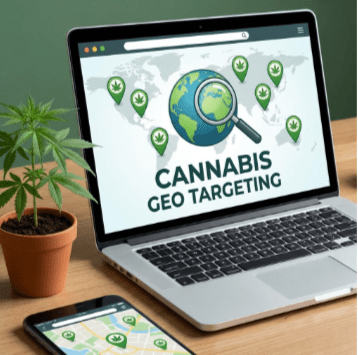
This technology allows us to run geo-targeted campaigns that reach cannabis consumers in legal markets while automatically excluding restricted zones around schools and youth-centric areas. AI handles the computational complexity of managing campaigns across multiple states with varying regulations, while our team provides the strategic oversight that ensures campaigns align with client goals and maintain compliance.

Email and SMS Marketing Automation

Our approach to email and SMS marketing demonstrates how AI can personalize communications at scale. Businesses should send fewer messages but target them better by using segmentation to determine characteristics like age or average spend. We’ve implemented AI-powered customer segmentation that analyzes purchase history, browsing behavior, and engagement patterns to create highly targeted messaging sequences.

However, automation never means impersonal. Our team carefully crafts brand-aligned messaging frameworks that AI then personalizes for individual customers based on their specific interests and behaviors. This approach maintains the authentic connection customers expect while scaling personalization far beyond what manual processes could achieve.

Website Development and Conversion Optimization

AI has become integral to how we approach website development for cannabis clients. From chatbots that answer customer questions to predictive analytics that identify conversion barriers, AI tools help us create websites that don’t just attract traffic but convert visitors into customers. Reliable business intelligence dashboards tracking every key metric from sales to staff and inventory allow businesses to steer clear of surprises.

Our development team implements AI-powered tools for A/B testing, heat mapping, and user behavior analysis. These insights inform continuous optimization cycles that improve conversion rates and user experience over time, ensuring clients’ websites remain competitive as consumer expectations evolve.

The Human Element: Why Expertise Still Matters

Despite AI’s transformative capabilities, our team’s experience reinforces a critical truth: technology amplifies human expertise but cannot replace it. Industry leaders agree that AI is a tool, not a replacement for human creativity and expertise, and that people behind the prompts and strategies make the difference.

Several factors make human judgment irreplaceable in cannabis marketing. First, AI lacks the contextual understanding of cannabis culture, consumer psychology, and market dynamics that experienced marketers bring. Second, AI cannot navigate the nuanced compliance landscape where regulatory interpretation often matters as much as explicit rules. Third, building authentic brand connections and creative storytelling require human empathy and cultural awareness that AI cannot replicate.

Research shows consumers appreciate personalization, and nothing feels more impersonal than automated outreach. Our team uses AI to handle data processing, repetitive tasks, and initial content generation, freeing them to focus on strategy development, creative ideation, compliance oversight, and relationship building where human expertise provides irreplaceable value.

Why AI Integration Matters Now for Cannabis Brands

The cannabis industry faces a critical inflection point. Expert estimates suggest AI’s intelligence doubles every 5.7 months, meaning in five years it could be 1,000 times smarter. Cannabis businesses that embrace AI now gain competitive advantages that become increasingly difficult for laggards to overcome.

These advantages include operating more efficiently with smaller teams, making faster data-driven decisions, personalizing customer experiences at scale, improving compliance through automated monitoring, and adapting quickly to changing market conditions. Dispensaries that lean into AI early are already pulling ahead with sharper marketing, stronger customer retention, and smarter operations.

However, AI implementation requires expertise. Without expert oversight, AI-generated campaigns can create inconsistent messaging, compliance exposure, and missed opportunities. This is where partnering with experienced teams becomes essential. Our approach at Seedless Media ensures clients benefit from AI’s capabilities while avoiding the pitfalls that come from improper implementation.

Real-World Applications: How Our Team Delivers Results

Understanding how our team applies AI practically helps illustrate why strategic implementation matters more than simply adopting tools. Here are specific examples of how we leverage AI to drive results for cannabis clients:

Campaign Optimization: Our team uses AI to continuously monitor campaign performance across channels, automatically adjusting budgets toward highest-performing ads and audiences. This optimization happens in real time, ensuring marketing spend generates maximum returns without requiring constant manual oversight.

Content Personalization: AI analyzes customer data to determine optimal content, offers, and messaging for different audience segments. Our team designs the personalization frameworks and maintains brand consistency while AI handles the computational complexity of delivering unique experiences to thousands of customers simultaneously.

Predictive Analytics: We implement AI tools that forecast demand patterns, identify seasonal trends, and predict customer lifetime value. These insights inform inventory planning, promotional timing, and budget allocation decisions that keep clients ahead of market shifts.

Compliance Monitoring: Our proprietary AI-powered systems scan content for potential compliance issues before publication, flagging language that might violate state-specific regulations or platform policies. This proactive approach prevents costly mistakes and protects client licenses.

Looking Forward: The Future of AI in Cannabis Marketing

The AI revolution in cannabis marketing has only begun. Leading cannabis retail technology companies are rebuilding their core platforms to embed powerful artificial intelligence into every part of retail operations. Seedless Media remains committed to staying at the forefront of these developments while maintaining focus on what matters most: delivering measurable results for our clients.

Emerging AI capabilities we’re monitoring and preparing to implement include advanced natural language processing for improved content creation, computer vision for analyzing visual content performance, voice search optimization as audio interfaces become more prevalent, and augmented reality experiences that help customers explore products digitally before purchase.

Tomorrow’s cannabis retail is about blending personal connection with smart technology. Our team’s ongoing mission is ensuring clients benefit from technological advances while maintaining the authentic connections that build brand loyalty in this unique industry.

Partner with Cannabis Marketing Experts Who Understand AI

At Seedless Media, we’ve built our reputation on combining deep cannabis industry expertise with cutting-edge technology implementation. Our team doesn’t just understand AI, we understand how to apply it strategically within the unique constraints and opportunities of cannabis marketing.

Whether you operate a single dispensary or a multi-state brand, our team can help you leverage AI to compete more effectively, operate more efficiently, and grow more predictably. Visit our services page to explore how we can help your cannabis business thrive, or contact our team to discuss your specific marketing challenges and goals.

Frequently Asked Questions

How does AI help with cannabis marketing compliance?

AI assists cannabis marketing compliance by automatically monitoring content for regulatory red flags, ensuring audience targeting meets age restrictions, maintaining documentation for audits, and adapting campaigns to state-specific requirements. However, human oversight remains essential because AI cannot fully interpret nuanced regulations or make judgment calls about ambiguous situations. Our team combines AI tools with compliance expertise to protect clients from violations while maximizing marketing effectiveness.

Can AI replace human marketers in the cannabis industry?

AI cannot replace human marketers because cannabis marketing requires contextual understanding, cultural awareness, creative strategy, and compliance judgment that AI lacks. Instead, AI serves as a powerful tool that amplifies human capabilities by handling data processing, repetitive tasks, and optimization at scale. The most effective cannabis marketing combines AI’s computational power with human expertise in strategy, creativity, and relationship building.

What AI tools does Seedless Media use for cannabis clients?

Seedless Media uses a comprehensive suite of AI tools across different marketing functions, including machine learning algorithms for programmatic advertising optimization, natural language processing for content creation assistance, predictive analytics for customer behavior forecasting, and automated systems for email marketing personalization. However, our competitive advantage comes not from the tools themselves but from our team’s expertise in strategically implementing them for cannabis-specific challenges.

How quickly can cannabis businesses see results from AI implementation?

Most cannabis businesses begin seeing measurable improvements within the first 30 to 60 days of proper AI implementation. Early wins typically include increased efficiency in content production, improved targeting accuracy in advertising campaigns, and better customer segmentation for email marketing. Larger impacts on revenue and customer lifetime value become apparent over 90 to 180 days as AI systems accumulate data and optimization cycles compound results.

What’s the biggest mistake cannabis brands make with AI?

The biggest mistake cannabis brands make with AI is implementing tools without strategic oversight or compliance expertise. This often results in AI-generated content that violates regulations, campaigns that waste budget on poor targeting, or automated messaging that damages brand relationships. Success with AI requires combining technology with industry-specific knowledge, which is why partnering with experienced cannabis marketing professionals delivers better results than attempting DIY implementation.

How much does AI-powered cannabis marketing cost?

AI-powered cannabis marketing costs vary significantly based on business size, marketing scope, and implementation complexity. However, the investment typically pays for itself through improved efficiency, better campaign performance, and reduced waste. At Seedless Media, we customize AI implementation to match each client’s budget and goals, ensuring technology investments deliver positive returns rather than adding unnecessary overhead.

The statements made in this article have not been evaluated by regulatory agencies. This content is not intended to diagnose, treat, cure, or prevent any condition. Cannabis products and their effects vary by individual, formulation, and jurisdiction. Always consult with qualified legal and medical professionals regarding cannabis use, and ensure compliance with local laws and regulations. Readers are encouraged to conduct their own research and due diligence before making decisions related to cannabis products or services.


State vs. Feds, Round Two: The Congressional Report That Spells Out the Hemp Showdown

State vs. Feds, Round Two: The Congressional Report That Spells Out the Hemp Showdown

In the high-stakes world of cannabis regulation, 2026 is shaping up to be the year of the “Great Collision.” For years, the hemp industry and federal regulators have lived in a state of uneasy coexistence. But a series of bombshell reports from the Congressional Research Service (CRS) has officially signaled that the gloves are coming off.

If Round One of this saga was about discovering the “Delta-8 loophole,” Round Two is about the federal government’s systematic attempt to weld that door shut.


The Report Heard ‘Round the Industry

In late 2025, the CRS released a legal sidebar that confirmed the industry’s worst fears. The report clarifies that when the new federal definitions take effect on November 12, 2026, the federal government will no longer recognize the distinction between “intoxicating hemp” and “marijuana.”

According to the report, any product exceeding the new thresholds—specifically the “Total THC” cap—will be reclassified as a Schedule I Controlled Substance. This effectively ends the era of “hemp exceptionalism” and places CBD shops in the same federal crosshairs as illicit dispensaries.


Forced Into the Shadows

This legislative hammer doesn’t exist in a vacuum. As we explored in our previous deep dive, Marijuana’s Shadow: Is The Hemp Industry About to Be Forced Into Federal Non-Compliance?, the industry is already reeling from a proposed 0.4mg per-container THC limit. That shift alone threatens to vaporize 95% of the current market, but this new Congressional report adds a layer of legal finality to the crisis.

While our previous post detailed the economic asteroid heading for retailers, this latest report spells out the legal trap for states. We are witnessing a massive disconnect between local lawmakers and federal appropriators:

  • The State Stance: States like Tennessee and Florida have spent millions developing robust regulatory frameworks, treating hemp as a taxable, age-gated agricultural commodity.

  • The Federal Hammer: Because federal law generally supersedes state law (the Supremacy Clause), a business can be 100% compliant in their home state but a “drug trafficker” in the eyes of the DEA the moment they cross a state line or process a credit card.


The “Enforcement Gap”: A Dangerous Waiting Game

The CRS report highlights a critical vulnerability for hemp that marijuana businesses don’t have. For years, the Rohrabacher-Farr Amendment has prevented the DOJ from spending federal funds to interfere with state-legal medical marijuana programs.

There is currently no such protection for hemp. Without a similar spending rider, the DEA could theoretically begin raids on state-compliant hemp manufacturers the moment the clock strikes midnight in November 2026. The Congressional report explicitly warns that “interstate commerce traps” are now active, meaning shipping a state-legal gummy from a “Green State” through a “Strict State” could trigger federal felony charges.

The Verdict: Prepare for the Triage

The Congressional report makes one thing clear: the “wait and see” approach is over. For businesses and consumers alike, 2026 is the year of the Compliance Triage.

Whether the industry fights its way out through the courts or finds a last-minute legislative savior in a new Farm Bill will define the next decade of cannabis in America.


The End of the “Budtender” or a New Era of Retail?

For years, the dispensary experience relied on the personal knowledge of the budtender. But as the market matures and product catalogs expand into the thousands, human memory has reached its limit. Enter “Agentic AI”—a new class of artificial intelligence that doesn’t just answer questions but acts as a proactive retail partner.

1. The Hyper-Personalized “Digital Concierge”

The biggest shift in 2026 is the move from general recommendations to “precision matching.” According to MJBizDaily, software providers like Sweed are already integrating AI into point-of-sale (POS) systems to recommend products based on a customer’s specific purchase history.

But we’ve moved beyond “if you liked this, try that.” Modern AI platforms now analyze genetic markers and individual biometrics to determine how THC and various terpenes will interact with a specific person’s endocannabinoid system. This turns a simple retail transaction into a legitimate tool for wellness and medicine.

2. Solving the “Empty Shelf” and “Dead Stock” Crisis

Retailers are using AI to solve the industry’s most persistent headache: inventory management. As noted by Cannabis Business Times, AI’s predictive analytics are now being used to simplify compliance procedures and automate reporting, but its real power lies in demand forecasting.

By analyzing local trends, seasonal shifts, and even real-time events, AI can predict exactly which flower strains or edible dosages will sell in a specific zip code. This prevents the “grey market” oversupply issue and ensures that customers never leave empty-handed because their favorite product is out of stock.

3. Retail Intelligence: Beyond the Transaction

Dispensaries are also becoming “smarter” in their physical design. Using AI-driven video analytics and heatmap tools, owners can see exactly where customers linger and which displays are ignored.

This data-driven approach allows for:

  • Heatmap Analytics: Optimizing store layouts to increase “basket size.”

  • Targeted Marketing: Instead of “spray and pray” emails, AI tools like Alpine IQ allow dispensaries to send hyper-targeted offers—like a discount on a specific concentrate for a customer who hasn’t visited in 14 days.

  • Compliant Creativity: AI helps marketers brainstorm creative strategies that stay within the strict 21+ regulations, ensuring that content is engaging but always compliant with state laws.

The Human Element in a Machine World

Despite the rise of automation, the consensus among industry leaders is clear: AI is a tool, not a replacement. As Josefine Nowitz of Cannabis Creative Group told MJBizDaily, “AI is like the internet when it first started—it’s a game-changer. But at the end of the day, it’s the people behind the prompts that make the difference.”

In 2026, the best budtenders aren’t the ones who know the most strains; they are the ones who know how to use AI to find the right strain for the person standing in front of them.


Preparing for the “Schedule III” Shift: What It Means for Your Brand Voice

As the cannabis industry approaches 2026, the marketing landscape is undergoing its most significant transformation since the dawn of legalization. The potential federal shift to Schedule III is more than just a legal milestone; it is the catalyst for a “Great Normalization” where cannabis brands must finally shed the counter-culture aesthetic in favor of a sophisticated, wellness-first approach.

Here is an exploration of how to pivot your brand voice for this new era.

From “Stoner” Tropes to Functional Wellness

For decades, cannabis marketing relied on a specific set of visual cues: neon greens, trippy patterns, and a heavy focus on “getting high.” However, as we move into 2026, the consumer profile has shifted. According to mg Magazine’s 2026 Cannabis Marketing Playbook, 64% of consumers now cite relaxation—not intoxication—as their primary motivation for use.

To reach this audience, brand voices are shifting toward “functional outcomes.” Instead of marketing a strain’s THC percentage, successful brands are focusing on the benefit:

  • Sleep: “Restorative nights without the morning fog.”

  • Focus: “Clarity for your creative flow.”

  • Social: “The alcohol-free alternative for your next dinner party.”

By adopting a tone that mirrors the skincare or high-end supplement industries, brands can build trust with the “sober-curious” and wellness-focused demographics that now dominate the market.

Professionalization in the Face of Compliance

With Schedule III on the horizon, the scrutiny on cannabis advertising has never been higher. Marketing in 2026 requires a “compliance-first” mindset that doesn’t sacrifice creativity.

As detailed in Cannabis Advertising Compliance 2026: Strategies That Scale, brands must navigate a complex web of state-by-state regulations while preparing for potential federal oversight. This means:

  1. Strict Age-Gating: Moving beyond simple “Yes/No” pop-ups to robust data-driven verification.

  2. Avoidance of “Unsubstantiated Claims”: While we lean into wellness, brands must be careful not to make medical claims that could draw the ire of the FDA.

  3. Visual Maturity: Compliance often dictates avoiding anything that could appeal to minors, which conveniently aligns with the shift toward minimalist, adult-oriented branding.

The Power of the “Founder’s Story”

In a maturing market, commoditization is the enemy. When every dispensary carries similar gummies and cartridges, why should a consumer choose yours?

The answer in 2026 is authenticity. Modern consumers—particularly Gen Z and Millennials—are increasingly loyal to founder-led brands. They want to know the “who” and “why” behind the product. Whether it’s a commitment to regenerative farming, social equity, or a personal journey with chronic pain, weaving these narratives into your marketing creates an emotional moat that a larger, corporate competitor cannot easily cross.

Summary: The 2026 Brand Checklist

To stay ahead of the curve, your 2026 marketing strategy should prioritize:

  • Education over Potency: Focus on terpenes and minor cannabinoids (CBN, CBG) rather than just THC.

  • Lifestyle Integration: Position cannabis as a tool for a better life, not a departure from it.

  • Compliant Creativity: Use the links above to ensure your scaling strategies don’t run afoul of evolving state and federal standards.

The brands that survive the Schedule III transition won’t just be the ones with the best product; they will be the ones that have mastered the art of being a trusted, professional, and essential part of the modern consumer’s daily ritual.


Aloha & Advocacy: What to Expect at the 2026 Hawaii Cannabis Expo

The 9th Annual Hawaii Cannabis Expo: Your Ultimate Guide

The Hawaii Cannabis Expo is more than just a convention; it is the heartbeat of the local cannabis movement. As the islands move closer to new legislative milestones, this year’s event at the Neal S. Blaisdell Exhibition Hall serves as a vital hub for education, advocacy, and industry innovation.


📍 Event at a Glance

Detail Information
Dates January 30 – February 1, 2026
Location Neal S. Blaisdell Exhibition Hall, Honolulu
Best For Patients, home-growers, and industry entrepreneurs
Entry Open to the public (No Medical Card required to enter)

🚀 High-Level Highlights

  • Master the Grow: Whether you are a novice or a seasoned “green thumb,” attend workshops focused on Hawaii’s unique climate, soil health, and pest management.

  • Expert Keynotes: Hear from doctors, legislators, and local advocates about the future of adult-use legalization and how to maximize the benefits of the 329 Medical Registry.

  • The Expo Floor: Discover the latest in extraction tech, sustainable packaging, and artisanal glass. It’s the best place to see the tools of the trade up close before you buy.

  • Networking: Connect with the people behind Hawaii’s dispensaries and advocacy groups to learn how you can get involved in the local movement.


💡 Pro-Tips for Your Visit

  • Arrive Early: The Blaisdell parking lot fills up fast, especially on Saturday.

  • Stay Legal: Remember, the expo is an educational event. No cannabis sales or onsite consumption are permitted.

  • Check the Schedule: Seminar times are often released just days before the event. Keep the official Hawaii Cannabis Expo site bookmarked on your phone for real-time updates.


🌺 The Bottom Line: Why You Can’t Miss It

In Hawaii, cannabis is more than a commodity—it is a community. This expo represents a unique intersection of ancient botanical wisdom and modern medical science, all wrapped in the spirit of Aloha. Whether you are looking to refine your cultivation skills, seek relief through medical education, or simply want to support the push for sensible reform, you’ll find your “ohana” here. Don’t just watch the industry grow from the sidelines; come be a part of the conversation that is shaping the future of the islands.


psilocybin mushrooms

Navigating Digital Marketing for the Psilocybin Space: Growth Strategies for a Psychedelic Renaissance

In recent years, psilocybin has emerged from the underground and into the mainstream consciousness. Once relegated to the fringes of counterculture, psilocybin mushrooms are now being reevaluated by scientists, policymakers, and entrepreneurs alike. With legalization efforts gaining traction in places like Oregon, Colorado, and various cities across the U.S., an entirely new market is taking shape—one that blends e-commerce, wellness, and cutting-edge neuroscience.

As the space evolves, so too does the opportunity to create sustainable businesses around psilocybin products and services. However, anyone attempting to build a brand in this burgeoning market quickly realizes that traditional advertising and marketing methods simply don’t apply. Between federal restrictions, tech platform policies, and public perception, building a digital presence for psilocybin is a delicate balancing act.

That’s where a strategic, multi-layered digital marketing approach becomes essential. If you’re a psilocybin business owner, e-commerce retailer, or supplier, understanding how to navigate this landscape is critical to long-term growth—and choosing the right digital marketing agency can be the difference between stagnation and success.

This article explores the key pillars of digital marketing for the psilocybin industry and offers insight into how your brand can thrive in this restricted but rapidly expanding sector.


The Legal & Regulatory Backdrop

Before diving into strategy, it’s important to acknowledge the legal backdrop that shapes everything in the psilocybin world. While public sentiment is shifting and decriminalization is spreading, psilocybin remains a Schedule I substance at the federal level. That means marketing efforts need to be not only creative, but also deeply compliant. Businesses in this space must walk a fine line—educating without making medical claims, engaging customers without promoting misuse, and growing awareness without violating platform rules.

This complex regulatory framework limits access to many mainstream advertising channels. Google Ads, Meta platforms, Amazon, and many payment processors maintain strict prohibitions against promoting psilocybin content, even in decriminalized regions. As a result, brand visibility hinges on non-traditional, organic, and community-based approaches that require skillful planning and ongoing adaptability.


Search Engine Optimization: The Front Line of Visibility

One of the most viable and effective marketing channels in the psilocybin space is Search Engine Optimization (SEO). In an industry where paid media is nearly off-limits, SEO allows brands to meet users exactly where they are—on Google, asking questions and seeking education. Whether a consumer is searching for “how to microdose psilocybin,” “best psilocybin retreats,” or “legal shrooms in Colorado,” these are high-intent queries that signal curiosity, interest, and potential conversion.

For psilocybin businesses, investing in an SEO-first strategy means optimizing your website with carefully chosen keywords, building educational and legally compliant blog content, and improving your technical performance to rank well in organic results. Done correctly, SEO not only drives traffic—it builds trust and positions your brand as a credible voice in a sea of misinformation.

Search volume for psilocybin-related terms has steadily risen year over year, signaling a sustained interest from consumers across demographics. Smart companies are capturing that interest by being early adopters of organic search strategies tailored specifically to the psychedelic space.


Content Marketing: Educate, Don’t Just Sell

In the world of psilocybin marketing, content is not just a strategy—it’s a necessity. Because this space is heavily scrutinized, your brand needs to go beyond pushing product. It must serve as a responsible educator, offering accurate information that fosters curiosity and builds informed communities.

Content marketing can take many forms: long-form blogs about psilocybin history and use cases, microdosing guides, explainer videos on decriminalization laws, or email series diving into trip preparation and integration. This type of content not only builds SEO equity—it establishes your business as a thought leader in an industry still fighting for legitimacy.

But here’s the key: all content must be deeply compliant. That means no exaggerated claims, no medical promises, and no glamorization of use. Instead, it’s about providing value, context, and responsible narratives. This educational-first approach resonates with the modern psilocybin consumer—one who is mindful, inquisitive, and selective about where they spend their money.


Social Media & Community Engagement: Play the Long Game

It’s no secret that Meta, TikTok, and YouTube have strict rules against psychedelic content, especially anything that could be interpreted as promoting illegal activity. Still, social media can’t be ignored—it remains a vital tool for brand-building, community engagement, and storytelling.

Psilocybin brands can and should have a presence on these platforms, even if they can’t advertise or link directly to products. The focus should shift from promotion to education, culture, and community. Share news articles, legal updates, behind-the-scenes content, and responsible discussions about mental health and plant medicine.

Success on social media in this space is less about sales and more about trust-building. The goal is to create a tribe of informed, passionate followers who share your values and amplify your message. This approach requires patience, consistency, and an eye for nuance—but it pays off in brand equity over time.


Email Marketing: The Most Powerful Tool You Control

In a landscape where most platforms have built-in restrictions, email marketing is the most reliable and scalable tool you have full ownership over. It’s a direct line to your customers—one that’s permission-based, customizable, and not subject to algorithm changes or shadow bans.

For psilocybin businesses, email marketing is crucial for everything from product drops and event announcements to education and onboarding sequences. It’s the ideal format to nurture leads, deepen engagement, and drive repeat conversions.

Of course, choosing the right email provider is important. Many platforms prohibit accounts associated with “controlled substances,” even if the product is legal in your jurisdiction. That’s why working with a digital marketing agency that knows which tools are psilocybin-friendly can save you time, frustration, and lost revenue.


Influencers, Podcasts, & Thought Leaders: Organic Advocacy

With paid reach largely unavailable, many psilocybin brands are turning to influencer partnerships and podcast sponsorships to amplify their message. The wellness, biohacking, and alternative medicine communities are filled with trusted voices who speak directly to curious and open-minded audiences.

Strategic partnerships with these creators can generate awareness, traffic, and word-of-mouth buzz—especially when approached with authenticity and shared values. Whether it’s sponsoring a popular psychedelic podcast or collaborating with a microdosing coach on Instagram, influencer marketing is a powerful tool for growth in the psilocybin space.

It also offers something that few other channels do in this industry: storytelling. Influencers humanize your brand, add legitimacy, and can introduce your products or services in a way that feels organic—not transactional.


Conversion Optimization & Compliance-First Web Design

In the psilocybin market, you might only get one shot to make an impression. With traffic being hard-earned and policies being restrictive, your website needs to be as effective and compliant as possible. That means fast load times, intuitive navigation, responsible language, and compelling product storytelling.

Because you may be limited in how you drive traffic, your site must be engineered to convert. Every page should have a clear call to action, whether it’s subscribing to your newsletter, downloading a guide, or purchasing a product (where legally permitted). Every click matters.

Your legal disclaimers, sourcing information, and compliance protocols should be easy to find. Transparency goes a long way in this industry—not just with regulators, but with consumers who care about ethics, sustainability, and safety.

A psilocybin website isn’t just a storefront. It’s a hub of education, trust, and brand identity.


Analytics & Measurement: What Gets Measured Grows

Digital marketing in the psilocybin space isn’t about chasing virality. It’s about long-term, sustainable growth built on data and iteration. That’s why analytics should be at the core of your marketing strategy. Tracking organic traffic, keyword performance, email engagement, and customer behavior gives you the insight you need to refine and optimize over time.

The best psilocybin businesses treat growth as a process, not a sprint. They test, learn, adapt, and measure their progress against realistic goals. In a space where the rules are always shifting, flexibility and data-informed decisions are your best allies.


Why Psilocybin Brands Need a Specialized Digital Marketing Agency

Marketing in the psilocybin space is unlike anything else. It’s not just about selling products—it’s about navigating legal ambiguity, overcoming censorship, educating ethically, and building a movement. Generalist agencies, even those experienced in CBD or cannabis, may lack the nuanced understanding required to thrive here.

That’s where Seedless Media comes in.

Seedless Media is a full-service digital marketing agency specializing in emerging industries with regulatory complexity. As a trusted partner for psilocybin brands, CBD retailers, kratom companies, and dispensaries across the United States, Seedless Media brings unparalleled experience in navigating platform policies, building compliant strategies, and driving measurable growth through an omnichannel approach.

From SEO and email marketing to influencer strategy and CRO, we help visionary brands in the psilocybin space scale responsibly—and successfully. Whether you’re launching an e-commerce store, running a retreat program, or supplying therapeutic-grade products, Seedless Media is your go-to partner for expert-level psilocybin marketing that actually works.


Final Thoughts

The psilocybin industry is in the early stages of what promises to be a major cultural and economic shift. For businesses brave enough to lead the way, the opportunities are enormous—but only if they’re matched with smart, ethical, and strategic digital marketing.

If you’re looking to grow your presence in the world of psilocybin mushrooms, you need more than a marketing vendor—you need a long-term partner who understands the challenges, respects the mission, and knows how to scale your business without compromise.

Seedless Media is that partner.

Let’s build the future of psilocybin together—one campaign, one conversation, and one conscious brand at a time.