Key Takeaways
- Dispensary advertising fails when compliance is an afterthought instead of the foundation.
- Google bans ads that promote cannabis sales, with narrow certified exceptions.
- Arizona now charges $20,000 per violation for unlicensed cannabis advertising.
- Programmatic display reaches regulated audiences on mainstream inventory without account risk.
- Email and SMS are owned channels that no algorithm can shadowban.
- Measure revenue and foot traffic, never impressions and vanity metrics.
Introduction
In a market built on shadowbans and shifting statutes, playing it safe is the quickest way to get left behind.
Most dispensary owners have lived this already. The ad account gets suspended on a Friday. The agency shrugs. The budget disappears, and nothing moves. Meanwhile, the shop three miles away keeps pulling new customers through the door.
The difference is rarely creative talent. It is structure. Compliant channels compound, and non-compliant channels collapse. That is the whole game.
Seedless Media was born from the love of cannabis, and we build every campaign around that reality. You can learn how our team approaches regulated growth before you spend another dollar. We do what we say we will do.
One note before we dig in. This article covers general marketing strategy, not legal advice. Cannabis rules change fast and vary by state. Confirm every campaign with a licensed cannabis compliance or legal professional first. All content here is intended for audiences 21 and over.
So where does the money actually go? Start with the failure points.
Why Most Dispensary Advertising Stalls Out
Three patterns show up again and again in dispensary ads that go nowhere.
The first is platform dependence. A dispensary builds its entire funnel on one paid channel. One policy update wipes it out overnight.
The second is generic execution. Cannabis content marketing gets outsourced to writers who have never read a state statute. The copy reads fine and converts nothing.
The third is bad measurement. Reach and impressions look impressive in a monthly report. They do not tell you whether anyone walked in.
Fixing all three starts in the same place, and it is not the creative brief.
Compliance First, Creative Second
Compliance is not the department that says no. It is the thing that keeps your campaigns running while competitors rebuild suspended accounts.
Arizona shows why this matters. Under HB2179, effective June 30, 2026, the rules got significantly tighter. Ads must identify the licensed establishment by name and license number. Digital placements require an audience that is at least 73.6% adult. The Arizona State Legislature summary of HB2179 spells out the enforcement side. Any individual or entity other than a licensed establishment faces a $20,000 civil penalty per violation.
Read that last part again. The penalty targets non-licensees. That includes agencies, affiliates, and the platform hosting the ad.
Product claims carry their own risk. The Federal Trade Commission has been direct with cannabinoid marketers on this. Its long-standing substantiation standards for health claims apply to this category too. If you cannot support a claim with hard evidence, cut it from the campaign.
Once the guardrails are set, you can decide where the budget actually belongs.
Organic Growth Is the Channel Nobody Can Switch Off
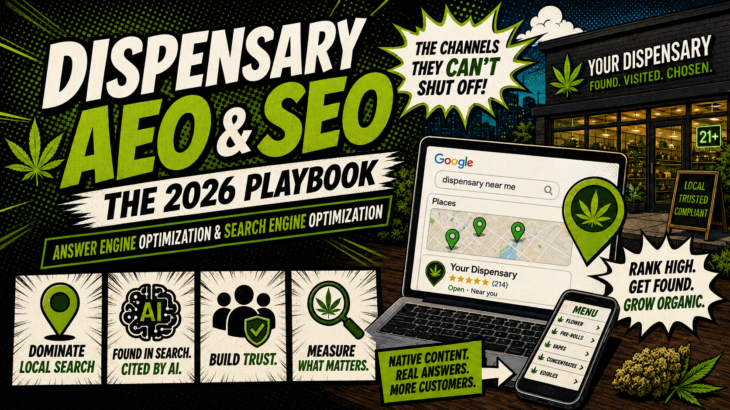
Search is the most durable asset a dispensary owns.
Nobody suspends a page-one ranking at 4pm on a Friday. Your Google Business Profile, your menu pages, and your local landing pages keep working while paid channels get reviewed. That is why our cannabis dispensary SEO work anchors most client programs.
Local intent is where the volume sits. Searches for a dispensary near a specific neighborhood convert at rates paid social rarely touches. Those searchers are already deciding.
Creative marijuana marketing lives here too. Strain education, budtender picks, and terpene guides all earn rankings that product pages cannot. Publish what your customers actually ask about at the counter.
Organic takes months to compound, though. So what do you run in the meantime?
Where Paid Dollars Actually Work
Paid cannabis advertising is not dead. It just does not live where most people look for it.
Google is explicit on this point. Its recreational drugs advertising policy permits ads for topical hemp-derived CBD products at 0.3% THC or less, with certification required. Ads promoting cannabis sales are not allowed.
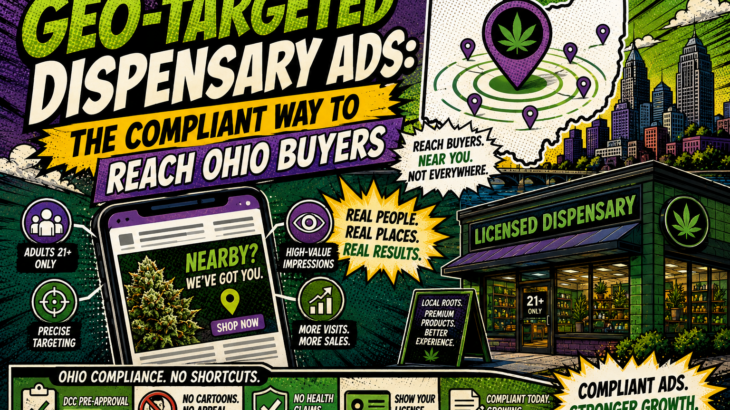
That pushes serious budget toward programmatic display. Endemic and mainstream inventory can be bought with strict geo-targeting and age thresholds baked into the buy. You can fence a radius around your store, or around a competitor. Our programmatic display and geo-targeting campaigns are built for exactly that.
Expert Insight: Your Landing Page Gets Reviewed Too
Most operators respond to an ad rejection by rewriting the headline. That almost never fixes it. Reviewers, human and automated, evaluate the destination page as part of the ad. A perfectly clean headline pointing at a live menu with pricing and a cart still reads as a sale. Fix the destination first. Then rewrite the creative.
Paid reach is rented, though. The next channel you actually own.
Own the Audience: Email and SMS
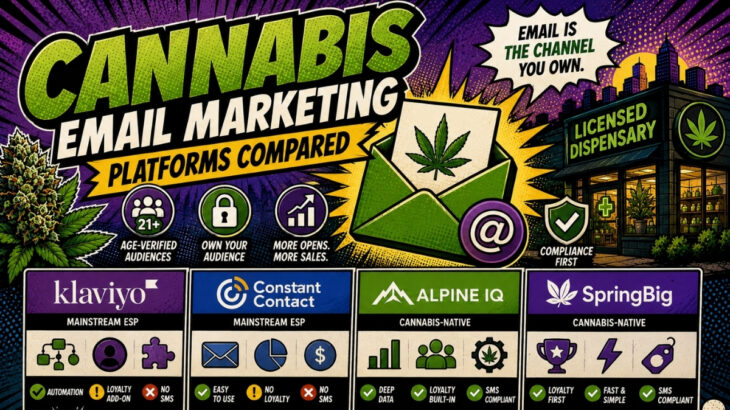
An email list is the only audience a platform cannot take from you.
Hyper-segmentation is where the returns show up. Split by purchase frequency, product category, and average basket size. A flower buyer and an edibles buyer should never get the same message. Our cannabis dispensary email marketing flows are built on that principle.
Text message marketing hits harder and carries more rules. Consent must be explicit and documented. The FCC extended its TCPA consent revocation deadline to January 31, 2027, which buys operators time. It does not change the core obligation.
Honor every opt-out immediately. Keep records of how each number joined your list. Clean data is cheaper than litigation.
Here is how the channels stack up side by side.
Dispensary Advertising Channel Comparison
| Channel | Platform Risk | Time to Results | Best Use |
| Local SEO and content | Low | 3 to 6 months | Compounding organic growth |
| Programmatic display | Low | 2 to 4 weeks | Awareness and geo-targeting |
| Google Ads | High | Days | Certified CBD topicals only |
| Email marketing | Low | Immediate | Retention and repeat visits |
| SMS marketing | Medium | Immediate | Time-sensitive promotions |
| Organic social | High | Ongoing | Cannabis culture and brand |
The pattern is hard to miss. The channels you own carry the least risk and the best margins.
Frequently Asked Questions
Is dispensary advertising legal in the United States?
Yes, dispensary advertising is legal in states with regulated markets. Rules vary by state. Most require age-gated audiences, a visible license number, and no content that appeals to minors. Federal platform policies still limit paid placement.
Can dispensaries advertise on Google Ads?
No, ads promoting cannabis sales are not allowed on Google. Certified advertisers may promote topical hemp-derived CBD with 0.3% THC or less. Most dispensaries advertise education, brand pages, or ancillary services instead.
Are programmatic display ads a compliant option for dispensaries?
Yes, programmatic display is one of the safer paid options available. Compliance depends on the buy. Set age thresholds, geo-fence your targeting, and verify that inventory meets your state’s adult-audience percentage requirement.
Is SMS marketing still worth the compliance overhead?
Yes, SMS is worth it when consent is properly documented. Open rates stay high, and delivery is immediate. Keep written proof of opt-in for every number and process every opt-out request without delay.
Does a dispensary really need a specialized marketing agency?
Yes, specialization matters in a regulated category. General agencies rarely track state advertising statutes. In several states, the penalty for a non-compliant ad can land on the agency, not only on the license holder.
The Bottom Line
Dispensary advertising is not about finding a loophole. It is about building a mix that keeps running when the rules shift again. Compliance-first structure, organic growth, and owned audiences do that work. Vanity metrics do not.
This article shares general marketing information and is not legal advice. Cannabis regulations change frequently and differ by state and municipality. Review every campaign with a licensed cannabis compliance or legal professional before launch. Content is intended for audiences 21 and over.
Let’s Scale Your Brand
You do not need another vendor promising reach. You need a partner who knows the statutes and reports on revenue. Seedless Media has driven more than $980,000 in tracked revenue for cannabis clients, backed by 30-plus years of combined experience. See who we are and how we work, then schedule your strategy call. Click and grow.